Skip to main menu Skip to content
Winter Hours (Jan. 5 - May 31): We are open Monday to Friday from 9am to 5pm. To schedule an appointment, please fill out our appointment form or email us at asc@torontomu.ca

Faded Blue: Cyanotypes from TMU’s Special Collections

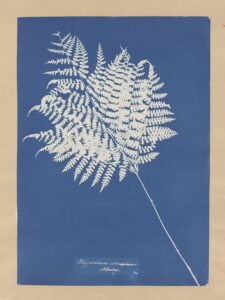
The colour blue connotes many things: emotion, temperature, depth, space. When a picture is washed in blue, it might feel melancholic and sad, or vast and optimistic like an open sky. In art, blue can be associated with Picasso’s blue period, or the Virgin Mary who is often garbed in blue cloth. When one thinks of blue in photography, they might think of colour as a whole, the alternative to black and white photography. Instead, let’s think of cyanotype.

Cyanotype is a photographic printing process invented in 1842 by Sir John Herschel. It is characterised by its striking blue monochrome. It is a relatively simple developing process, but never gained large momentum in the photographic world due to its distinctive colour. It instead became popular with architects and draughtspeople since it is considered the first photocopying process and is also known as blueprints. This is where we get the term ‘Blueprint’ from, the cyanotype copy of the original architectural drawing.

Sir John Herschel was a pioneer of photography. He was one of the many inventors racing to come up with a means to permanently capture an image. Though he helped others who have been credited with the invention of photography, he is solely credited with cyanotype. The process was not popular when it was introduced. Many were not a fan of the deep blue colour, preferring the more neutral black and browns seen in contemporary photography of the time. Instead, it was picked up by botanists to document and share the natural world.

Anna Children Atkins was a British botanist. She used cyanotype to copy images of plants, allowing her to better study their physical characteristics. Atkins studied botany during the 19th century, a time when women were pushed away from many scientific fields. She published “British Algae” in 1843, which was composed of many cyanotypes and captured the forms of algae and other plants in Britain.

The distinctive blue colour is not all that characterises cyanotypes. Like many prints and photographs, cyanotypes fade when exposed to light. Their blue becomes dull and grey, reduced to a faded white. This can all be easily reversed – which is unique to these blue toned images. The blue will reappear after the image has been placed in darkness. Though light is often a danger to fine art and photography, it is only a temporary nuisance for cyanotypes.

From their invention in the mid 19th century, cyanotypes have been a niche photographic process. Their striking blue tones are beautiful, and faded colour can be brought back by some time away from light. Come see a sample of the cyanotypes in TMU’s Special Collections this January. Take inspiration from its scientific history, its use in artist photographs, its popularity in architecture, or simply enjoy its blue hues.


Bibliography:

Anderson, Christina. Cyanotype : The Blueprint in Contemporary Practice. Routledge, 2019. https://doi-org.ezproxy.lib.torontomu.ca/10.4324/9780429441417

Lotzof, Kerry. “Anna Atkins’s cyanotypes: the first book of photographs.” Natural History Museum. https://www.nhm.ac.uk/discover/anna-atkins-cyanotypes-the-first-book-of-photographs.html

Schaaf, Larry J. “The Cyanotypes of Pioneering Photographer Anna Atkins.” National Gallery of Canada, November 26, 2020. https://www.gallery.ca/magazine/your-collection/the-cyanotypes-of-pioneering-photographer-anna-atkins

Ware, Mike. Cyanotype : The History, Science and Art of Photographic Printing in Prussian Blue. Science Museum, 1999.
A Few of our Favourite Things

Archives and Special Collections have so many weird and wonderful items in our collections. For the summer we decided to feature some of them in an exhibition in the display windows in front of our reading room.

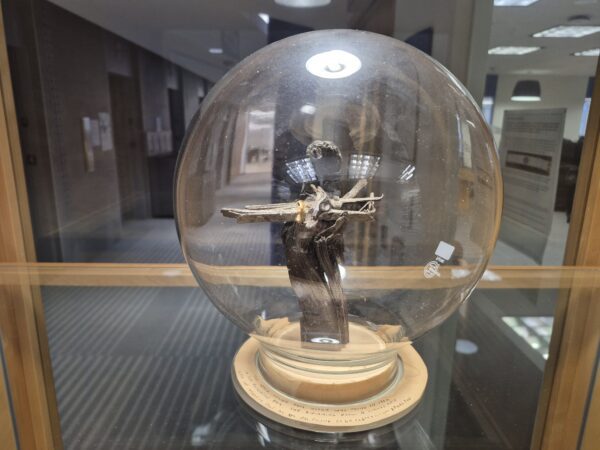
Wood in Glass (RG 0.04.21)

Clear glass sphere with large piece of wood with smaller piece of wood glued to it inside

These two wood pieces were found during the excavation of the site for the pool located in Kerr Hall. This piece, along with another section of wood donated at the same time to the Archives, were purportedly carbon dated at 12,000 years old. It is unclear who displayed them in this glass bowl or created this display piece.

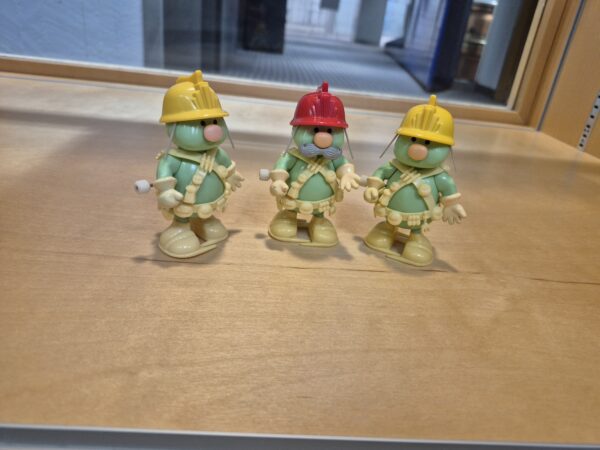
Doozers (2012.005.05.07)

Three small green plastic figures with hard hats on.

Doozers, small industrious workers found living in harmony with the Fraggles on Jim Henson’s “Fraggle Rock”. These small plastic wind up figurines are an examples of some of the promotional materials created to advertise the show that originally aired 1983-1988. These figures are part of the larger Robert Hackborn fonds in Special Collections. Robert Hackborn worked for the CBC for nearly 4 decades on set design and creation, and visual effects. He worked on Fraggle Rock with the late Jim Henson. You can learn more about Robert Hackborn and this amazing collection by reading our blog on the topic: “The Man Behind the Glass: Robert Hackborn

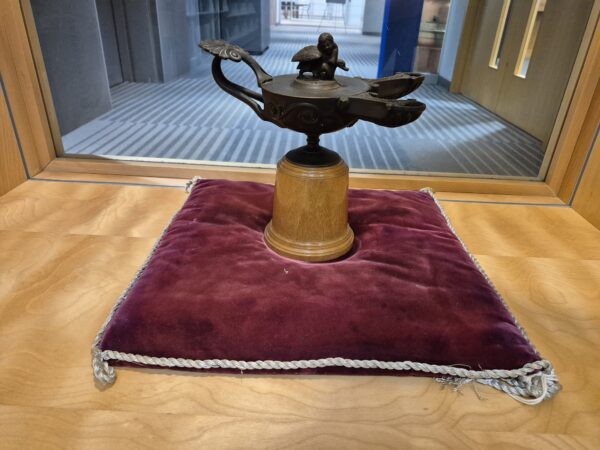
Lamp of Learning (RG 0.04.23)

metal oil lamp on a cylindrical wood base. It is sitting on a red velvet pillow

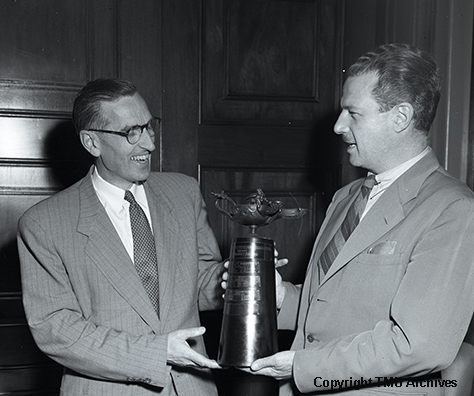
Legend has it that the lamp was purchased by a faculty member in a small shop in Rome, Italy in the 1950’s. It was brought back to the school and graced the top of the Chariot Race trophy. Chariot races were held at TMU in the 1950s and 1960s – usually in conjunction with football games.

Howard H. Kerr, TMU's first principal, and D. G. W. McRae, head of the Architecture program, with the Chariot Race trophy (RG 95.1.28.03.01), image
Howard H. Kerr, TMU’s first principal, and D. G. W. McRae, head of the Architecture program, with the Chariot Race trophy (RG 95.1.28.03.01)

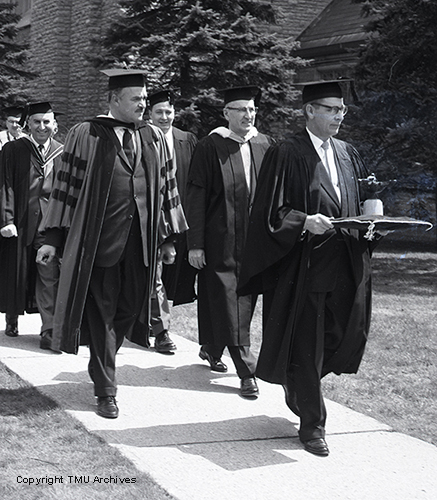
In the late 1950’s the lamp was removed from the trophy, fastened to the wood cylinder it currently resides on and used to lead the stage party into Convocation. The Lamp of Learning was used at convocation until the 1980s.

Lamp being carried after Convocation 1961 held at Deer Park Baptist. Lamp carrier was Professor J. Handley. Immediately behind him is Ontario Premier John Robarts, walking with School Principal Howard H. Kerr, image
Lamp being carried after Convocation 1961 held at Deer Park Baptist. Lamp carrier was Professor J. Handley. Immediately behind him is Ontario Premier John Robarts, walking with School Principal Howard H. Kerr

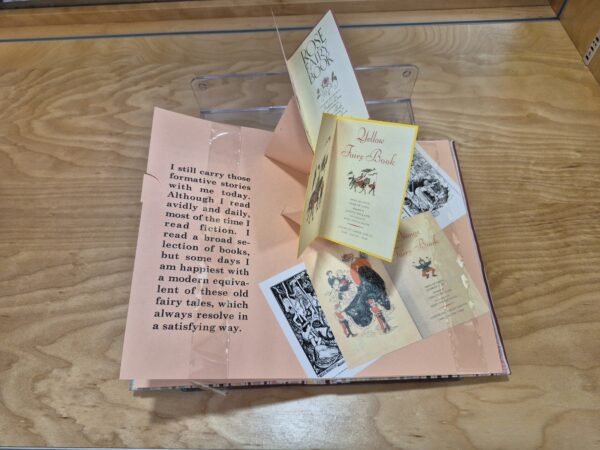
“Library Book” by Lise Melhorn-Boe (N7433.4 M445 L52 2005)

Pop up book open showing various small books

An artists’ book about reading library books. Created by Melhorn-Boe, this limited edition hardcover pop-up book features a story authored by Wendy Cain, a renowned Canadian paper and printmaker, about how she came to read all of Andrew Lang’s colour fairy books. It features copies of H. J. Ford’s illustrations from Lang’s books.

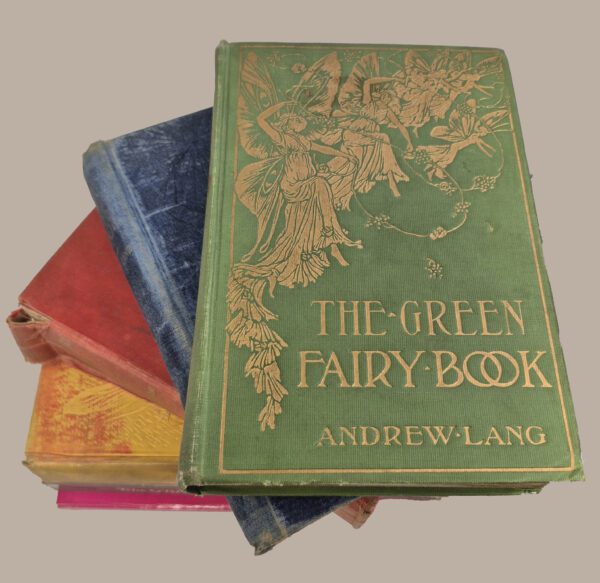
Green, Blue, Red, Yellow, Grey, and Pink Fairy books by Andrew Lang are part of the book collection in Archives and Special Collections, image
Green, Blue, Red, Yellow, Grey, and Pink Fairy books by Andrew Lang are part of the book collection in Archives and Special Collections

There are 12 Fairy books in total – Some of which can be viewed in the Archives and Special Collections reading room. Find them and other artist’s books by searching the library’s catalogue https://library.torontomu.ca/

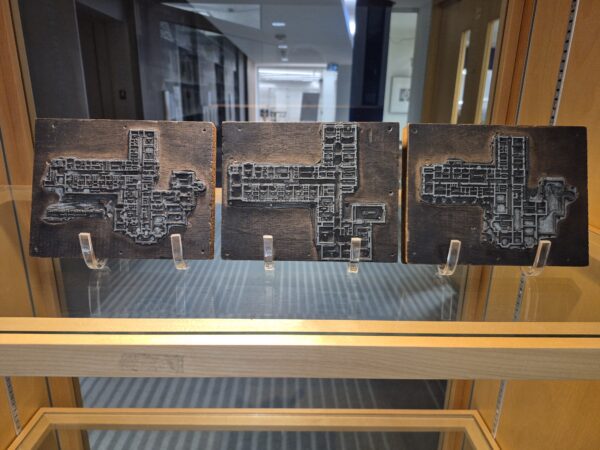
Wellesley Hospital floor plan wood block printing plates (RG 946.02.12.04)

Three wood blocks with metal floor plan designs attached to them

Three wood block printing plates, created by Architect Frederick C. Lee, featuring the original 1912 floor plans for the Wellesley Hospital. The blocks are part of the Wellesley Hospital School of Nursing Alumnae Association collection that came to Archives and Special Collections in 2011. If you want to learn more about the collection, The Wellesley Hospital School of Nursing, and how it came to be associated with TMU please consider reading the following blogs:

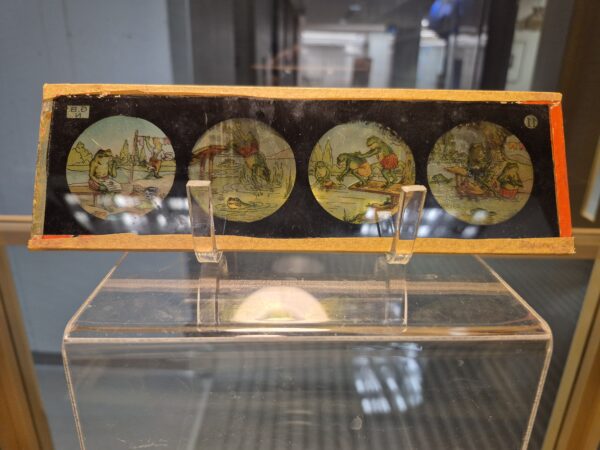
Magic Lantern Slide “Frogs” (2017.010.06.034)

Rectangular glass slide with 4 images of frogs in swimsuits jumping and playing in the water

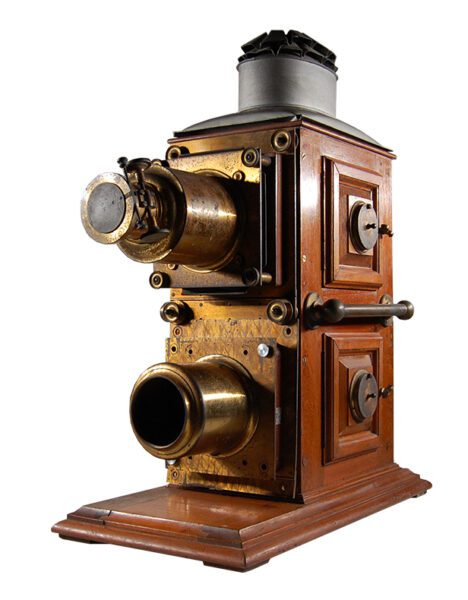
Magic Lantern Slides were initially rectangular strips of glass with hand painted imagery and a mahogany wood border. Illustrations on the glass portion went from being hand-painted to mechanically produced, and by the mid 1800s photographic slides came into production as well. This slide is part of a larger donation of magic lantern and stereograph technology from the late Dr. Martin J. Bass and Gail Silverman Bass in 2018.

The slides were projected by Magic Lanterns. The first time a magic lantern was constructed is considered to be in 1659 and were used for entertainment. The lanterns were first illuminated using candles or oil lamps, but this did not produce enough light to project a clear image from afar. Limestone began being used in the early 1800s, allowing for projection of the slides in large settings. By the mid 1800s, a huge variety of magic lanterns became available to the professional and home market. During this time they were also used more widely in educational settings. For more information on Magic Lanterns and Lantern slides please take a look at our earlier blog in the topic https://library.torontomu.ca/asc/2017/10/new-exhibition-projecting-magic/

Foundation of the University Archives (RG 12.192.004.009)

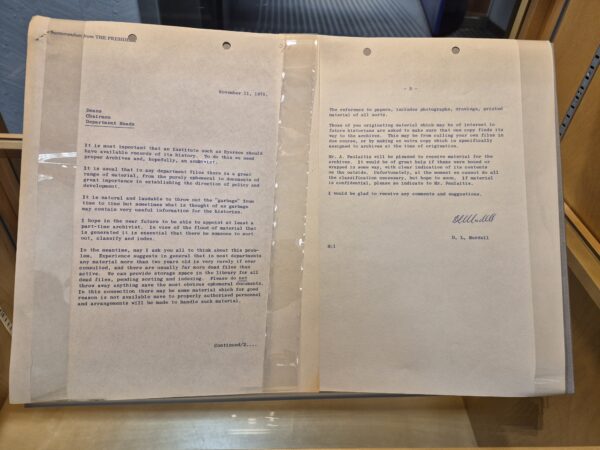
2 page memo regarding collecting materials for an archives

This 2 page memo was sent by then school President Donald Mordell in November of 1970 encouraging all Deans, Chairmen and Department heads to stop discarding university records as “It is natural and laudable to throw out the ‘garbage’ from time to time but sometimes what is thought of as garbage may contain very useful information for the historian”. This memo was sent out before there was even an established archives or an archivist hired. The Archives was established in 1971 as a result of a recommendation in the the Smyth Commission Report (RG 220.54). The first Archivist Jim Peters was a member of the English Faculty. If you want to learn more about the foundation of the Archives you can view the following blogs:

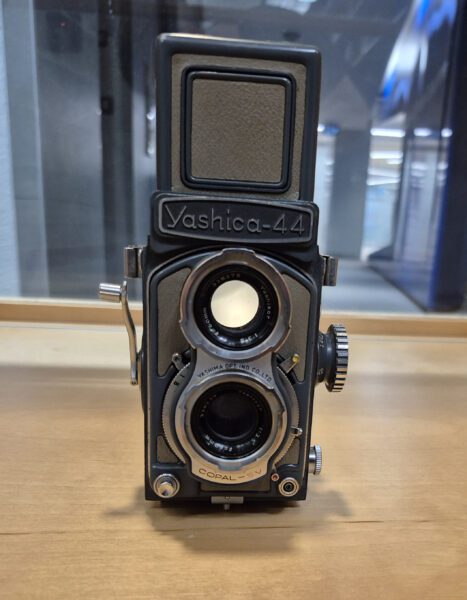
Yashica-44 camera (2005.006.12.08)

The Yashica-44 series camera was first produced in 1958 by the Yashica Company (founded in 1949 in Nagano, Japan). The 44 model is a crank wind twin reflex camera with a waist level viewfinder and was advertised to be 25% smaller than their full reflex camera and weighed only 26oz. Three variations were created (44, 44A and 44LM) and production of the cameras continued until 1965. The camera used 127mm film and created black and white or colour 4 cm x 4 cm images – usually slides.

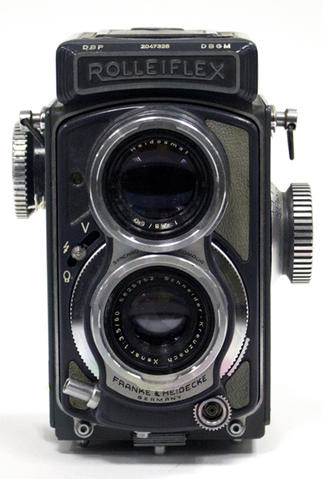
Baby Rollei Camera, c1957 (2005.006.12.06), image
Baby Rollei Camera, c1957 (2005.006.12.06)

The Yashica-44 was based on the Baby Rollei Camera produced by Franke & Heidecke, a German Company founded by Paul Franke and Reinhold Heidecke in 1920. Both of these cameras are part of the Heritage Camera Collection and were donated to Special Collections by Wilhelm E. Nassau in 2011. You can learn more about twin lens reflex cameras by following this link https://archives.library.torontomu.ca/index.php/twin-lens-reflex-cameras

To see more of what Archives and Special Collections has to offer or to do research please contact us at asc@torontomu.ca.