Skip to main menu Skip to content
Spring/Summer hours (May 4 - Aug 31): Monday to Friday 9am - 4pm, by appointment only. To schedule an appointment, please fill out our appointment form or email us at asc@torontomu.ca

The Conservation of the Collingwood Photographic Collection

In 2021, the Special Collections accepted a donation of 35854 photographs of the late Canadian photographer Grant Collingwood. Approximately 31788 of those were various sized negatives, and only 4066 were photographic prints. Over the last five years, the Special Collections staff, Young Canada Works interns, and placement students of Toronto Metropolitan University’s Film and Photography Preservation and Collections Management (F+PPCM) program have sequentially collaborated with one another by cataloging and re-housing the thousands of materials. Ultimately, passing the Collingwood baton off and leaving behind notes of advice to support the next project archivist.

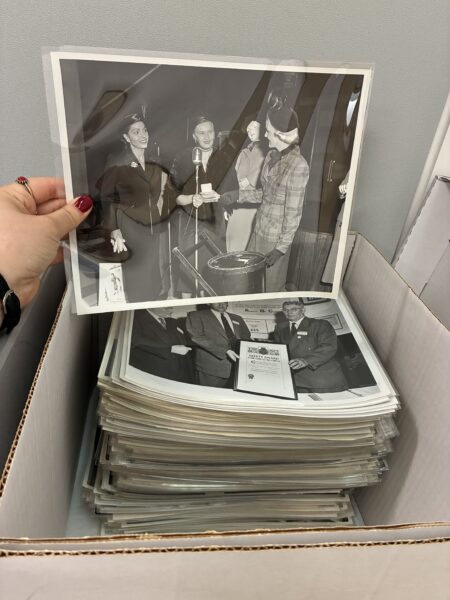
Over time, not only have filled bankers boxes transformed into orderly archival document cases, but archivists have learned new skills: how to read cursive handwriting, how to infer decades by utilizing context clues in the photographs when no handwritten date is available, and various conservation methods to unstick film negatives. The advice left behind has come in especially handy, as in the Spring of 2026 I opened a bankers box to have it reveal stacks of approximately 570 gelatin silver prints, none of which were dated and all of which were stuck together from water damage. Throwing them out would be a disservice to Special Collections as it was 14% of the prints in the Collingwood collection. It would also be a disservice to researchers. Was it worth the risk of throwing them out and losing documents of research value? We decided that it was not. 

The first attempt to unstick the gelatin silver prints was to use the humidity chamber materials that were left behind by the Summer 2025 F+PPCM placement student. She learned the conservation of unsticking damaged negatives. I followed her instructions, I used a clear storage box that was 7 inches deep, I placed a microfiber cloth at the bottom. I poured in hot water from the kettle to be absorbed by the cloth, and I placed a metal shelf organizer from Ikea and on top and left the gelatin silver prints to rest. I sealed the lid of the box and plastic wrapped the entire unit to ensure the humidity stayed inside of the chamber. Unfortunately, due to the severe damage done to the gelatin silver prints, the humidity was not successful in releasing them from one another the way it had for the negatives, they remained stuck and hard as a rock. 
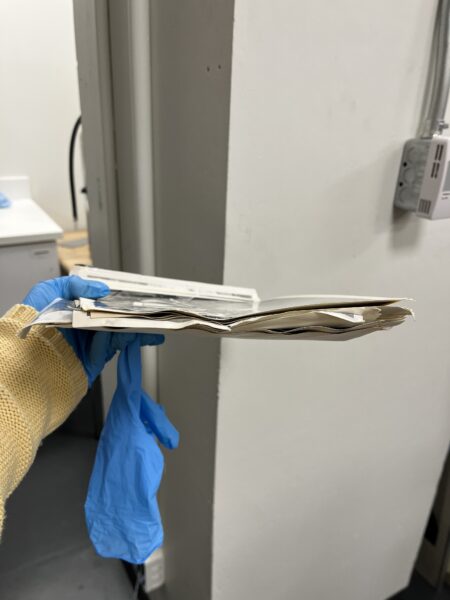
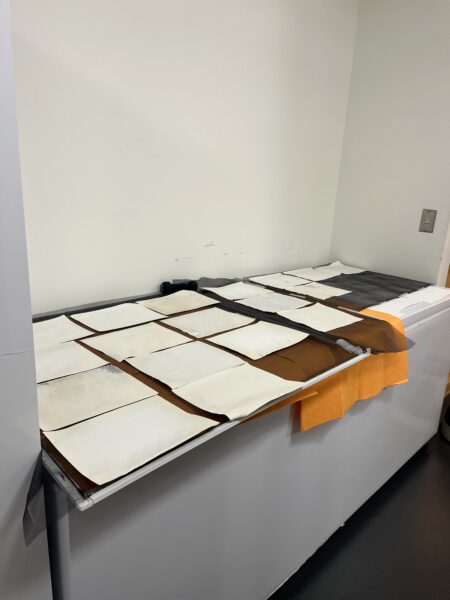
The Special Collections team used our photography backgrounds to decide on the next steps to take. With some additional research, we agreed that gelatin silver prints could be saved the same way in which they are made in the darkroom; by submerging them in water and laying them flat to dry. It felt risky to put archival documents into a wet bath, when liquid near any archival documents is often strictly forbidden. However, since the alternative was to just throw them away, we decided it was worth the risk. Before purchasing the additional supplies, we were fortunate to borrow equipment from the Technology Resource Centre (TRC) at the university as they have the supplies needed for the darkroom on campus. We borrowed a 16” x 20” developing tray, one set of print tongs, and a multi-purpose squeegee. We could not complete this without an acrylic sheet. Since the TRC did not have this available, we purchased an acrylic serving tray from our nearby dollar store. We also could not complete this without materials to suspend prints so that they did not stick to the table when drying, so we purchased a ‘fine screen roll’ from the nearby Canadian Tire used for common household windows.

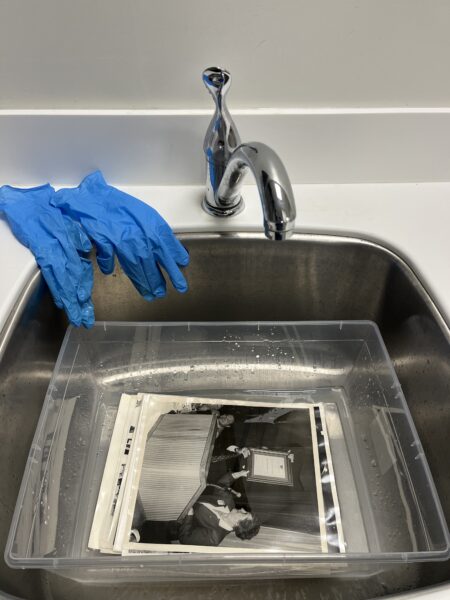
I filled the development tray with warm water and submerged the gelatin silver prints. I monitored them to see if they would lift, and we were correct in our hypothesis as the water encouraged them to go from hard as a rock to silky and slippery and I was able to pull them apart with the print tongs. Separating them one by one, I walked them individually by holding the corners of the print like I would the train of a delicate wedding dress. I placed them on a window screen which fit about thirty prints and took anywhere from half a day to a full day for them to dry. In our newfound success, we returned the materials to the TRC and purchased our own supplies to have indefinitely. 

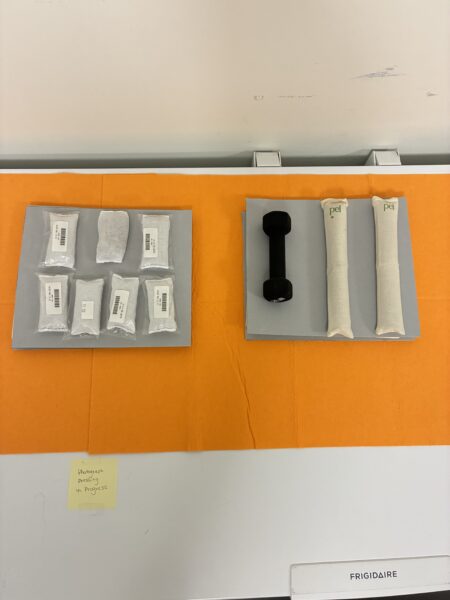
Since the prints were stuck together in various piles, all of which were inconsistently numbered, I used the humidity chamber to keep the stack of prints moist when needed, as allowing them to fully dry out and re-wet would cause further damage. I was also careful to not have them be left wet over the weekend, as extended periods of dampness and humidity made the emulsion lift off and ruined the entire photograph. The wet-to-dried prints were not sticky, and it caused no issues to stack them on one another. Although many of the prints did curl up, by layering them between acid free folders that hugged the prints, using layered acid free boards, and various sized archival or gym weights sitting atop, we pressed them for a week and they flattened right down. At last, we stored them in individual archival safe plastic sleeves and prepped them to be catalogued. 

As there were 570 prints to re-wet and pull apart, the project took four months to complete, starting in March and ending in June. The project was so successful that only a fair few prints did not make the cut and were thrown out in the process. However, as none of the prints have a date scrawled across the back of them, it will be a task passed off to the next project archivist to determine what decade they belong to for our arrangement which is chronological order by year and subdivided by subject matter. And just like that, the Collingwood baton is passed off to continue its project archivist relay race. 
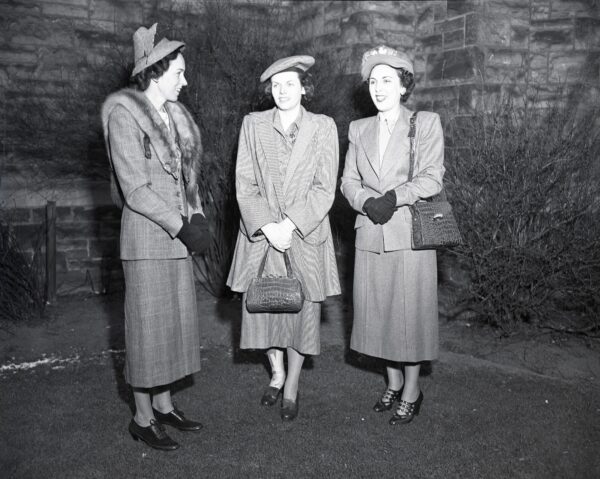
From Fox Furs to Mini Skirts: Collingwood’s Fashion Snapshots from the 1940s–1970s

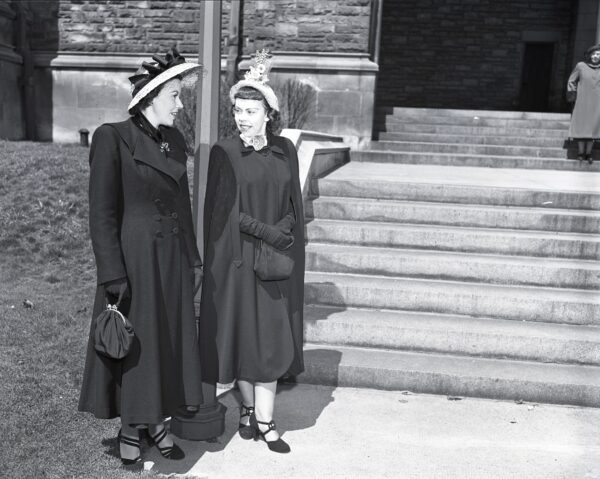
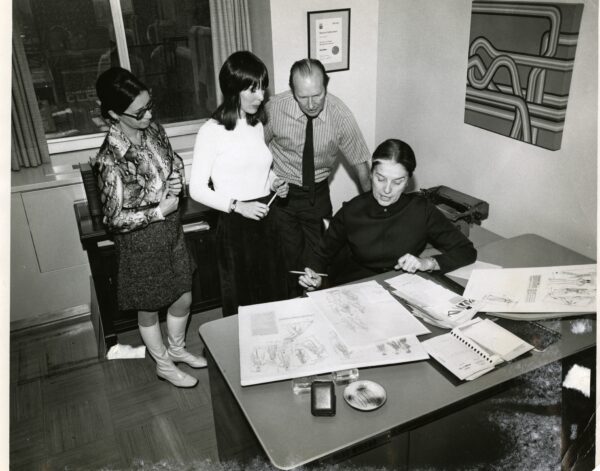
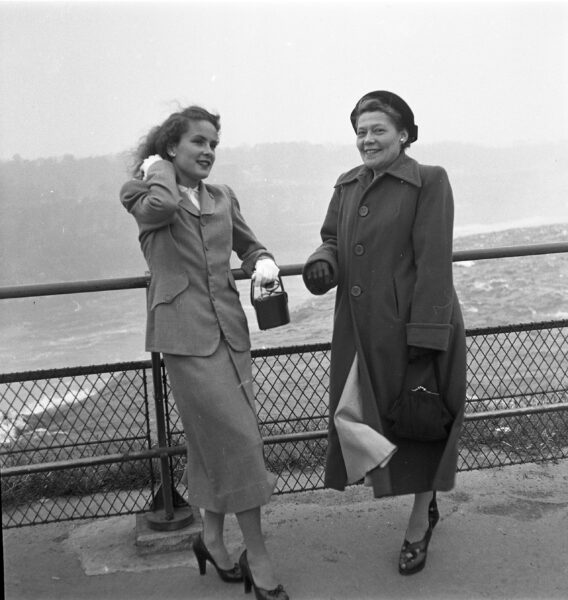
When I come across Grant Collingwood’s photographs from the 1940s and 1950s, I often admire that people are dressed in similar threads. Omnipresent in his early work are the tailored suits that are the true stars of the show. The cinched waist jacket, tweed with suede felted elbows, and just a few buttons at the navel, accompanied by a skirt just below the knees, usually paired with a hat; pillbox or beret, take your pick if not for the pincurls to win in the end.

For a really special occasion, a taxidermy fox was slyly, and perhaps frighteningly, draped around the neck. After all, how was one to distinguish oneself from the 1940s Vogue encouraged wartime utilitarian silhouette? Although it’s not my style, I am often fascinated by the evidence of decades past and the ways in which fashion and gender roles solidified themselves in photographs, as seen with the war-time uniform. Consequently, Collingwood was such a prominent photographer, he captured so many fashion waves, sometimes just incidentally. 

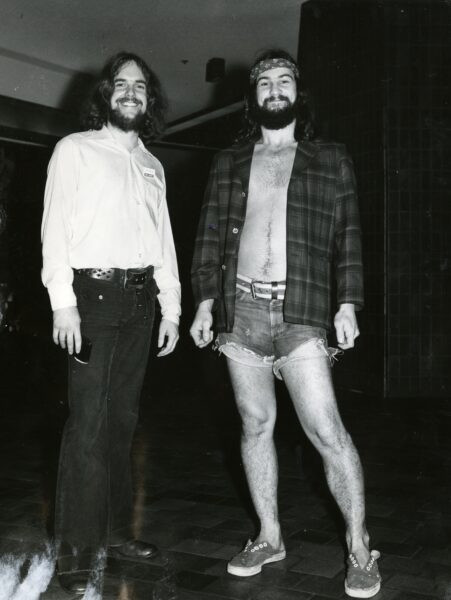
The decades came and went, and their history and politics shaped fashion. Skirts inched up the leg in protests in the late 1940s, and they became known as “the mini” by the 1960s. Not long after men’s shorts followed in-suit. In the reverse, short hair grew longer for both men and women.

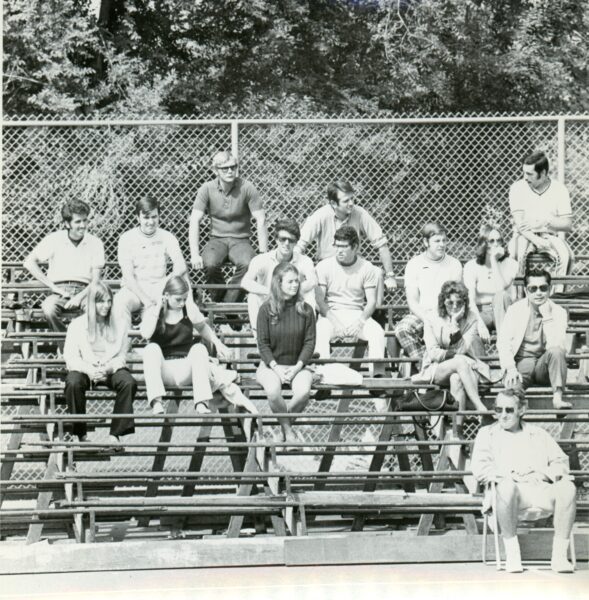
Shoes grew so many straps they birthed themselves into a sleek go-go boot. People lost their joie de vivre with hats, so the sun protective accessory inched down the face and transformed into statement sunglasses instead. The tweed went away and bold patterns took their place. Fashion became less about what to wear to work and serve your country in, and more about how to assert your civil rights, and with that the trends varied, the uniform disappeared and we were introduced to disco glam.

These snapshots are just a select few from over 30,000 in the collection to choose from. Most often, Collingwood organized his photographs and negatives by date which made accessioning them all the more easy. Sometimes, however, we are met with a box of undated work where fashion trends graciously allow us to rely on them to anchor the photograph into a decade. 

References:

Ramzi, Lilah. “A 1960s Fashion History Lesson: Mini Skirts, Mods, and The Birth of Boho,” Vogue, May 1, 20234. https://www.vogue.com/article/1960s-fashion-history-lesson

Ramzi, Lilah. “A 1940s Fashion History Lesson: Wartime Utility Suits, the New Look, and More Trends of the Decade,” Vogue, April 19, 2024. https://www.vogue.com/article/1940s-fashion-history-lesson

Victoria and Albert Museum. “An introduction to 1960s fashion,” Last modified April 17, 2024. https://www.vam.ac.uk/articles/an-introduction-to-1960s-fashion

Marisa Kelly is a second-year Master’s student in the Film + Photography Preservation and Collections Management program. She is completing her six-month residency at Special Collections, where she has worked closely with the Grant Collingwood photographic fonds and the Canadian Architect magazine fonds. She holds her Bachelor of Arts (Honours) in Visual and Critical studies from OCAD University.

Film from the Falls: Grant Collingwood’s Tourist Snapshots

Opening a bankers box to re-house Canadian photographer Grant Collingwood’s collection of film negatives is met with an exciting luck of the draw, as each box contains hundreds of closed envelopes with subject matter that varies from one envelope to the next. 

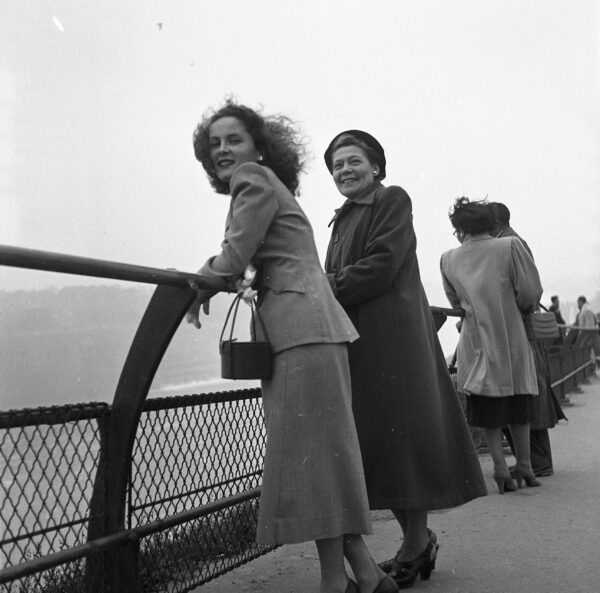
Collingwood’s career spanned about five decades (1940s–1990s), during which, to his credit, he titled the housings in which his negatives were kept by name of the person or the content, and always by the year that it was taken. Even so, Collingwood was a busy man, and as such, his photographic content varied considerably. In 1952 alone, he was commissioned to capture a variety of subjects, including graduations, wedding anniversaries, personal portraits, and commercial booths at the Canadian National Exhibition (CNE), among others. However, in pockets between work, he found time for leisure, and on an overcast day in November of 1952 off he went with friends to photograph the monumental magic that is Niagara Falls. 

The Falls themselves have roots in Indigenous culture and story telling, and hold their own various documentation; spanning from tourist photographs, daredevil attempts, and attractions such as the Maid of the Mist and Journey Behind The Falls. 

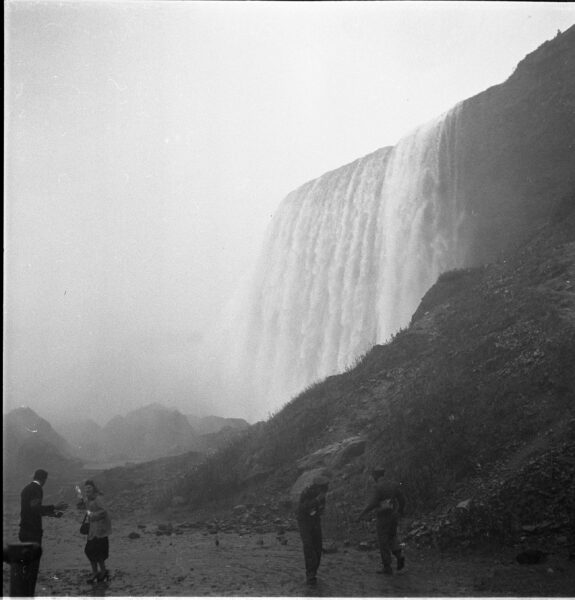
From the early Onguiaahra Indigenous tribes in the region, their word “Ongiara” evolved into “Niagara” by way of mispronunciation done by French colonists. It translates to “Thunder of Waters,” and according to the Niagara Falls National Heritage Area, it is estimated that every second, 3,160 tons of water flow over the Falls, totalling 75,750 gallons over the American and Bridal Veil Falls and 681,750 gallons over the Horseshoe Falls. So, as I pulled out a perfectly square 6 x 6 negative from one of Collingwood’s envelopes titled “At Niagara Falls” I gawped at the photograph of Collingwood and others at the bottom of the vast waterfall, with seemingly just a small rubble hill and some rocky earth between them and the roaring water. 

Scroll through the gallery to see more from the Collingwood Collection.

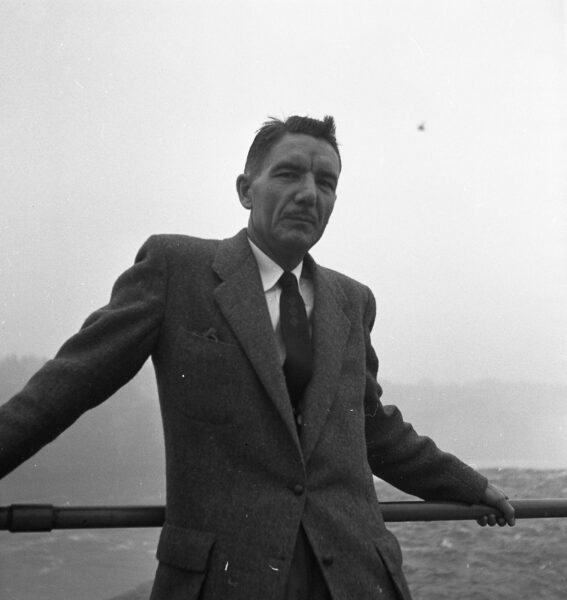
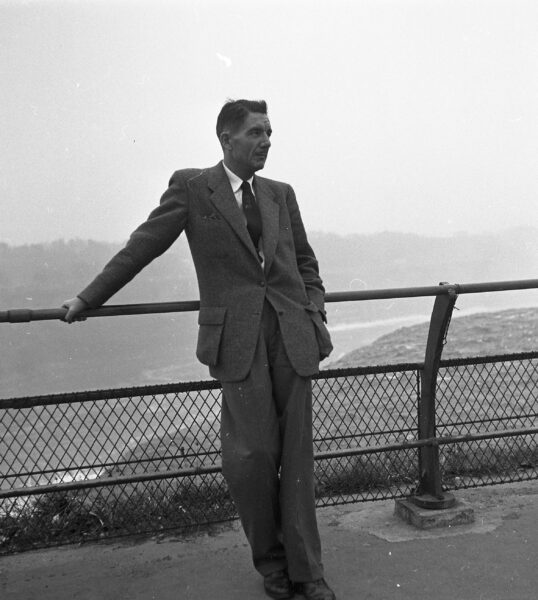
As I sifted through the additional photographs, I admired the posed portraits of wind swept hair, posh shoulder padded jackets, trench coats with voluminous buttons, suit jackets and ties, and vintage square totes in tow with people all along a fenced pathway so close to the waters edge they could reach out and touch it. 

Seven years later, in June 1959, the New York Times reported on tourist renovations on Niagara Falls and its surrounding areas. Today, a tourist can book a paid ticket for Journey Behind The Falls and view the Horseshoe Falls from behind a tunnel cozied in a rain coat. But, in 1952, it seems one would have to look no further than to wander onto the sandy earth, and true to 1950s fashion and technology, a closer look at the photograph below the Falls reveals a woman walking the terrain in heels and a man with what appears to be a Rolleiflex at his chest, also wishing to capture the event. Nothing like taking a trip for a simple jaunt out on the day to observe a nearby Natural Wonder of the World. 

References

“History Underfoot.” The Exchange, Niagara Falls, https://nfexchange.ca/hub/history-underfoot

“Journey Behind the Falls.” Niagara Parks, https://www.niagaraparks.com/visit/attractions/journey-behind-the-falls/

“Niagara Falls Being Renovated For Tourists.” George Adams, New York Times, June 14, 1959. https://ezproxy.lib.torontomu.ca/login?url=https://www.proquest.com/newspapers/niagara-falls-being-renovated-tourists/docview/114659247/se-2.

“Spectator Sport: There’ll Always be A Gawper.” Bruce West, The Globe and Mail, July 24, 1952. https://ezproxy.lib.torontomu.ca/login?url=https://www.proquest.com/newspapers/spectator-sport/docview/1287260794/se-2.

“The Dewatering of Niagara Falls.” Niagara Falls National Heritage Area, https://www.discoverniagara.org/the-dewatering-of-niagara-falls

Marisa Kelly is a second-year Master’s student in the Film + Photography Preservation and Collections Management program. She is completing her six-month residency at Special Collections, where she has worked closely with the Grant Collingwood photographic fonds and the Canadian Architect magazine fonds. She holds her Bachelor of Arts (Honours) in Visual and Critical studies from OCAD University.