Opening a bankers box to re-house Canadian photographer Grant Collingwood’s collection of film negatives is met with an exciting luck of the draw, as each box contains hundreds of closed envelopes with subject matter that varies from one envelope to the next.
Collingwood’s career spanned about five decades (1940s–1990s), during which, to his credit, he titled the housings in which his negatives were kept by name of the person or the content, and always by the year that it was taken. Even so, Collingwood was a busy man, and as such, his photographic content varied considerably. In 1952 alone, he was commissioned to capture a variety of subjects, including graduations, wedding anniversaries, personal portraits, and commercial booths at the Canadian National Exhibition (CNE), among others. However, in pockets between work, he found time for leisure, and on an overcast day in November of 1952 off he went with friends to photograph the monumental magic that is Niagara Falls.
The Falls themselves have roots in Indigenous culture and story telling, and hold their own various documentation; spanning from tourist photographs, daredevil attempts, and attractions such as the Maid of the Mist and Journey Behind The Falls.
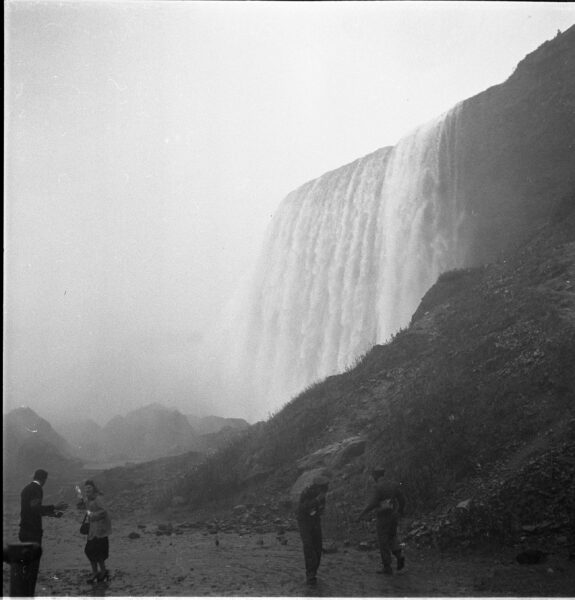
From the early Onguiaahra Indigenous tribes in the region, their word “Ongiara” evolved into “Niagara” by way of mispronunciation done by French colonists. It translates to “Thunder of Waters,” and according to the Niagara Falls National Heritage Area, it is estimated that every second, 3,160 tons of water flow over the Falls, totalling 75,750 gallons over the American and Bridal Veil Falls and 681,750 gallons over the Horseshoe Falls. So, as I pulled out a perfectly square 6 x 6 negative from one of Collingwood’s envelopes titled “At Niagara Falls” I gawped at the photograph of Collingwood and others at the bottom of the vast waterfall, with seemingly just a small rubble hill and some rocky earth between them and the roaring water.
Scroll through the gallery to see more from the Collingwood Collection.
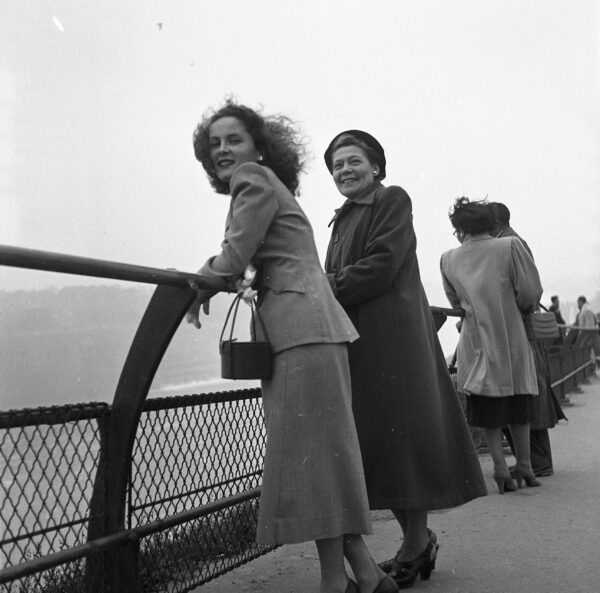
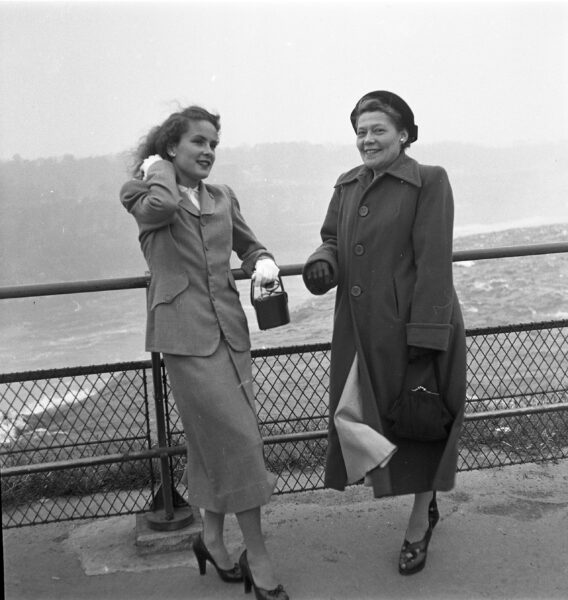
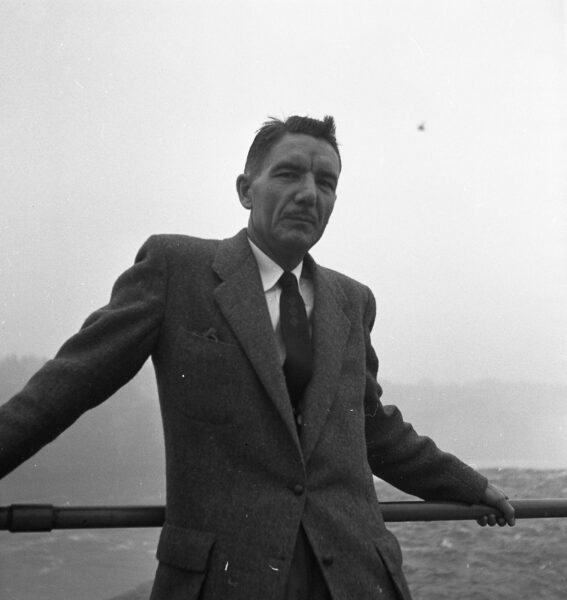
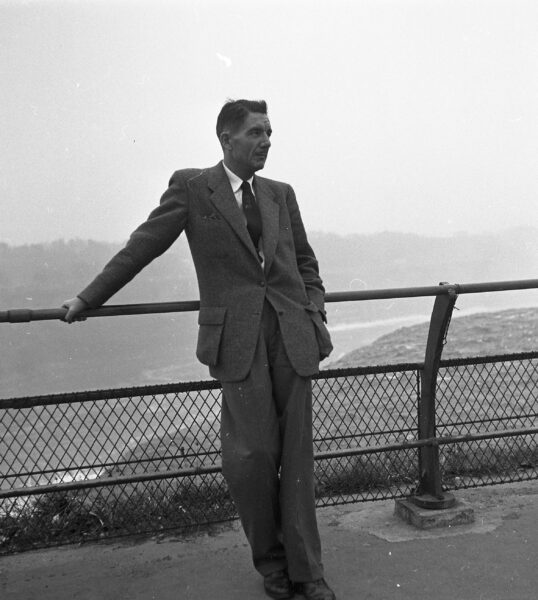
As I sifted through the additional photographs, I admired the posed portraits of wind swept hair, posh shoulder padded jackets, trench coats with voluminous buttons, suit jackets and ties, and vintage square totes in tow with people all along a fenced pathway so close to the waters edge they could reach out and touch it.
Seven years later, in June 1959, the New York Times reported on tourist renovations on Niagara Falls and its surrounding areas. Today, a tourist can book a paid ticket for Journey Behind The Falls and view the Horseshoe Falls from behind a tunnel cozied in a rain coat. But, in 1952, it seems one would have to look no further than to wander onto the sandy earth, and true to 1950s fashion and technology, a closer look at the photograph below the Falls reveals a woman walking the terrain in heels and a man with what appears to be a Rolleiflex at his chest, also wishing to capture the event. Nothing like taking a trip for a simple jaunt out on the day to observe a nearby Natural Wonder of the World.
References
“History Underfoot.” The Exchange, Niagara Falls, https://nfexchange.ca/hub/history-underfoot
“Journey Behind the Falls.” Niagara Parks, https://www.niagaraparks.com/visit/attractions/journey-behind-the-falls/
“Niagara Falls Being Renovated For Tourists.” George Adams, New York Times, June 14, 1959. https://ezproxy.lib.torontomu.ca/login?url=https://www.proquest.com/newspapers/niagara-falls-being-renovated-tourists/docview/114659247/se-2.
“Spectator Sport: There’ll Always be A Gawper.” Bruce West, The Globe and Mail, July 24, 1952. https://ezproxy.lib.torontomu.ca/login?url=https://www.proquest.com/newspapers/spectator-sport/docview/1287260794/se-2.
“The Dewatering of Niagara Falls.” Niagara Falls National Heritage Area, https://www.discoverniagara.org/the-dewatering-of-niagara-falls
Marisa Kelly is a second-year Master’s student in the Film + Photography Preservation and Collections Management program. She is completing her six-month residency at Special Collections, where she has worked closely with the Grant Collingwood photographic fonds and the Canadian Architect magazine fonds. She holds her Bachelor of Arts (Honours) in Visual and Critical studies from OCAD University.