Skip to main menu Skip to content
Winter Hours (Jan. 5 - May 31): We are open Monday to Friday from 9am to 5pm. To schedule an appointment, please fill out our appointment form or email us at asc@torontomu.ca

Faded Blue: Cyanotypes from TMU’s Special Collections

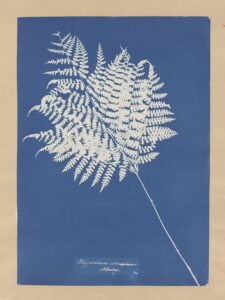
The colour blue connotes many things: emotion, temperature, depth, space. When a picture is washed in blue, it might feel melancholic and sad, or vast and optimistic like an open sky. In art, blue can be associated with Picasso’s blue period, or the Virgin Mary who is often garbed in blue cloth. When one thinks of blue in photography, they might think of colour as a whole, the alternative to black and white photography. Instead, let’s think of cyanotype.

Cyanotype is a photographic printing process invented in 1842 by Sir John Herschel. It is characterised by its striking blue monochrome. It is a relatively simple developing process, but never gained large momentum in the photographic world due to its distinctive colour. It instead became popular with architects and draughtspeople since it is considered the first photocopying process and is also known as blueprints. This is where we get the term ‘Blueprint’ from, the cyanotype copy of the original architectural drawing.

Sir John Herschel was a pioneer of photography. He was one of the many inventors racing to come up with a means to permanently capture an image. Though he helped others who have been credited with the invention of photography, he is solely credited with cyanotype. The process was not popular when it was introduced. Many were not a fan of the deep blue colour, preferring the more neutral black and browns seen in contemporary photography of the time. Instead, it was picked up by botanists to document and share the natural world.

Anna Children Atkins was a British botanist. She used cyanotype to copy images of plants, allowing her to better study their physical characteristics. Atkins studied botany during the 19th century, a time when women were pushed away from many scientific fields. She published “British Algae” in 1843, which was composed of many cyanotypes and captured the forms of algae and other plants in Britain.

The distinctive blue colour is not all that characterises cyanotypes. Like many prints and photographs, cyanotypes fade when exposed to light. Their blue becomes dull and grey, reduced to a faded white. This can all be easily reversed – which is unique to these blue toned images. The blue will reappear after the image has been placed in darkness. Though light is often a danger to fine art and photography, it is only a temporary nuisance for cyanotypes.

From their invention in the mid 19th century, cyanotypes have been a niche photographic process. Their striking blue tones are beautiful, and faded colour can be brought back by some time away from light. Come see a sample of the cyanotypes in TMU’s Special Collections this January. Take inspiration from its scientific history, its use in artist photographs, its popularity in architecture, or simply enjoy its blue hues.


Bibliography:

Anderson, Christina. Cyanotype : The Blueprint in Contemporary Practice. Routledge, 2019. https://doi-org.ezproxy.lib.torontomu.ca/10.4324/9780429441417

Lotzof, Kerry. “Anna Atkins’s cyanotypes: the first book of photographs.” Natural History Museum. https://www.nhm.ac.uk/discover/anna-atkins-cyanotypes-the-first-book-of-photographs.html

Schaaf, Larry J. “The Cyanotypes of Pioneering Photographer Anna Atkins.” National Gallery of Canada, November 26, 2020. https://www.gallery.ca/magazine/your-collection/the-cyanotypes-of-pioneering-photographer-anna-atkins

Ware, Mike. Cyanotype : The History, Science and Art of Photographic Printing in Prussian Blue. Science Museum, 1999.
Allan Gardens: Exploring Local History

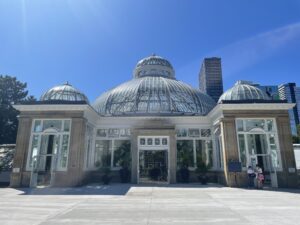
On the edge of campus sits Allan Gardens, a lush and well shaded park with a conservatory housing a variety of plants. The building, consisting of five green houses, is free and open to the public. Being in the heart of the city, the site has been a popular leisure spot for much of Toronto’s history. 

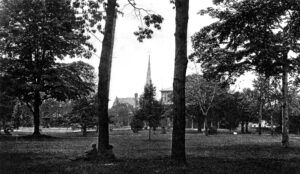
Allan Gardens c. 1900, looking from Carlton Street South-Westward. The old three storied wooden Pavilion is visible through the trees, as is the spire of Jarvis Street Baptist Church.
(F 121.02 – Tom Kilner fonds)

The current park sits between Jarvis Street and Sherbourne Street, and Carlton Street, and Gerrard Street East. The park was officially opened in 1860 by the Prince of Wales (who would become Edward VII) during a rainy day. It shares its inaugural day with Queen’s Park making it one of Toronto’s oldest parks. The area has a much longer history though. The land was given to the Horticultural Society by the garden’s namesake, George William Allan (1822-1901), the 11th Mayor of Toronto. The city later bought the park from the Horticultural Society in 1888 for $40,000. The park did not receive its current name until 1901, and was known at that time as the Horticultural Gardens. Torontonians wanted to ensure that the park commemorated the man who initially set the park in motion, G. W. Allan. Unlike High Park which continued to maintain its original name after the donor John George Howard’s death, people wanted the Horticultural Gardens to reflect the man who originally gave it to the Horticultural Society. It was then decided to rename the park Allan Gardens.

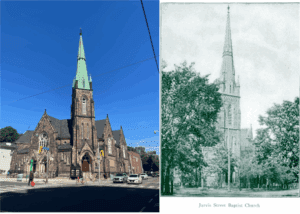
Jarvis Street Baptist Church has been a constant neighbor to the park as seen in this photograph taken today and from the photograph in the book “Souvenir Views of Toronto, Canada” published 1922.
(FC3097.37 .S688 1922 pam)

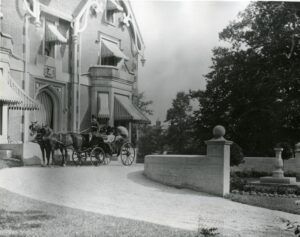
W. Allan had built his home, Homewood Estate just north of the land. The building went through many owners and eventually became the Wellesley Hospital in 1911, where in 1912 the Wellesley Hospital School of Nursing opened. Though Homewood was demolished in 1962, it would have stood near the corner of Sherbourne Street and Wellesley Street.

Homewood Estate, home of the garden’s namesake William Allan
(RG 946.01.03.03.02 – The Wellesley Hospital School of Nursing Alumnae Association fonds)


The size of the park has expanded throughout its years. It began as an oval five acre of land. The City and the Horticultural Society slowly expanded its perimeters to the size that it is today. The conservatory has also changed since its inception. It began as an open-air pavilion for concerts and other similar events, centered in the middle of the gardens. A three-storied wooden and glass structure, known as the Pavilion and designed by Toronto architects Langley & Langley soon replaced it in 1878. During its time it hosted many events, and was the only large concert hall in the city. The Pavilion burned down on June 6th, 1902 leaving the city void of any space suitable for large public gatherings. 

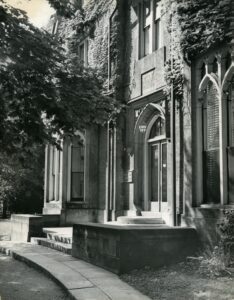
Homewood passed through a few owners until it became the Wellesley Hospital in 1911.
(RG 946.01.03.03.06 – The Wellesley Hospital School of Nursing Alumnae Association fonds)

With the loss of such an important space, some Toronto aldermen saw the need to build a replacement conservatory for the many plants it once held. By 1908 some aldermen were already pleading with city council to build a Palm house using some of the funds from the insurance money received after the fire. After much debate, the city eventually turned to City Architect Robert McCallum to replace the conservatory. He designed at least two structures, one similar to the lost wooden structure, offering a three storied assembly hall with 2000 seats. The chosen design is the current structure that we see today, a more modest-sized Palm house built in 1910.  

Allan Gardens is home to a variety of plants and even a small bale of turtles. The five rooms of the conservatory provide five different environments for different plants to flourish and include arid and tropical climates. The orchid collection has always been especially revered, once having rare blue orchids on display. The Palm House, which is the main showpiece of the conservatory, has been recently renovated and is now open again to the public. 

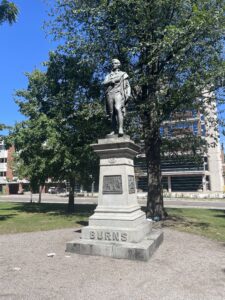
In the east end of the park stands a monument for Scottish poet Robert Burns. The statue is the work of David Watson Stevenson, and was unveiled in the park after a parade and much celebration July 21, 1902. The monument has stood for over 100 years, and still stands in the park today.  

Statue of Scottish poet Robert Burns, as it stands today near Sherbourne Street.

Today Allan Gardens continues to be a place of gathering, and site seeing. The newly renovated conservatory houses many plants and hosts many events including a weekly farmer’s market throughout the summer. Musical entertainment and various learning events are also hosted at the Gardens throughout the year.

Visit the Archives & Special Collections to view the many items we have on display this month that provide more information about Allan Gardens.


Bibliography

Biographical Dictionary of Architects in Canada. “McCallum, Robert.” Accessed August 20, 2025. http://dictionaryofarchitectsincanada.org/node/1474 

“Chance for Philanthropy Suggested to Ald. Foster.” The Toronto Daily Star, March 19, 1908. http://ezproxy.lib.torontomu.ca/login?url=https://www.proquest.com/newspapers/page-1/docview/1435626990/se-2

Friends of Allan Gardens. “Allan Garden’s History.” Accessed August 20, 2025. https://www.friendsofallangardens.ca/allan-gardens-history

“Howard Park and Allan Park.” The Toronto Daily Star, July 30, 1901. http://ezproxy.lib.torontomu.ca/login?url=https://www.proquest.com/newspapers/page-4/docview/1427865761/se-2

Middleton, Jesse Edgar. The Municipality of Toronto: A History. The Dominion Publishing Company, 1923.

 “Scottish Men Honor Burns: Monument of the National Poet Unveiled To-day in Allan Gardens.” The Toronto Daily Star, July 21, 1902. http://ezproxy.lib.torontomu.ca/login?url=https://www.proquest.com/newspapers/page-3/docview/1429249031/se-2.