Skip to main menu Skip to content
Winter Hours (Jan. 5 - May 31): We are open Monday to Friday from 9am to 5pm. To schedule an appointment, please fill out our appointment form or email us at asc@torontomu.ca

A Contest that is for the Dogs!

Help us name the Oakham House dogs
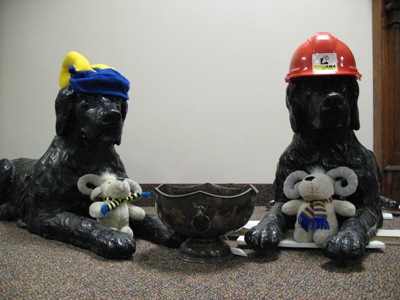
The Ryerson Archives are the proud owners of a beautiful set of matching Labrador Retrievers. They have settled in and gotten used to their new home and now it is time to give them names!

The contest is open to all University faculty, staff and students, and there is only one rule: The names MUST have significant meaning to Toronto Metropolitan University. This can include either historical (The Archives is a good place to look for this!) or contemporary significance. So enter and win prizes for first, second, and third place AND have your picture taken with the Archives’ mascots!

A bit of history on the dogs

The dogs were designed by architect William Thomas to hitch horses to and were located in front of his Oakham House residence. Thomas lived in the house until his death in 1860. The house was sold to another family and then in 1899 the house, along with the dogs, was sold to the Society for Working Boys- a home for disadvantaged youth in Toronto.  When Toronto Metropolitan University acquired  the building in 1958, the dogs, originally located at the building’s Church Street entrance, were no longer there.  They had been removed to the new location of the Boys Home.  When Ryerson retrieved the dogs in 1982, the Toronto Historical Board wanted the pair to be mounted in their historical place in the front of the house.  In the interest of protecting them from vandalism they were placed inside the house, and then adopted by the Archives in 2010.

Please send your name suggestions, along with an explanation as to why you chose those names, to archives@ryerson.ca.  Please include your full name and a number or email address where you can be reached should your submission be chosen.  Contest closes April 8th, 2011.
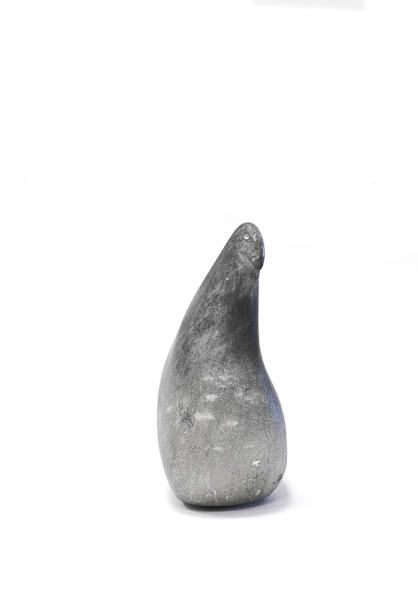
Raw Materials: Inuit sculpture from the Sylvia A. Morley Collection

In the early 1950s, the first large scale north-south cultural exchanges in Canada established the market for what we now refer to as Inuit Art. The first communities to begin selling their work to a southern market in any organized way were Inukjuak and Puvirnituq (Quebec) and Cape Dorset/Kinngait (Baffin Island).  The sculptures from this early period tend to be small, easily transportable works created by what was still a nomadic people. In the late 1950s and early 60s, carving became a significant source of income within newly formed Inuit-owned co-operatives, and for many today it continues to provide a living while also supplying the means to express pride in their culture and their craft.

Special Collections received a donation of Inuit sculpture from a former Ryerson student who actively collected, both through galleries in the Toronto area and in person at northern co-ops. The small display on the Library’s 4th floor offers us an opportunity to discuss the use of materials from different regions, as she collected examples from across the Arctic (perhaps favouring Baffin Island and Labrador), and the growing art production within the Inuit communities over the latter half of the 20th century. The display also precedes the opening of a much larger exhibition of contemporary Inuit art scheduled to open at the Art Gallery of Ontario on April 2nd: Inuit Modern: The Samuel and Ester Sarick Collection. To learn more about these items and their creators, visit Special Collections and the AGO this spring.

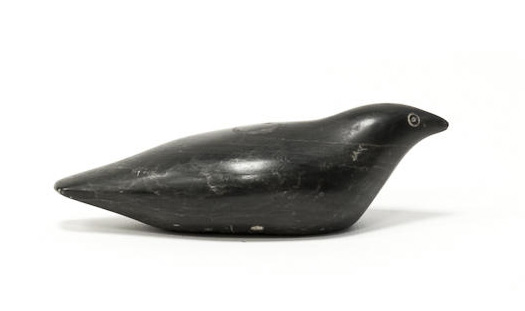
Miki, Andy, 1918-1983 Bird figure, abstract [date unknown] stone, dark to light grey Arviat, Kivalliq region of Nunavut

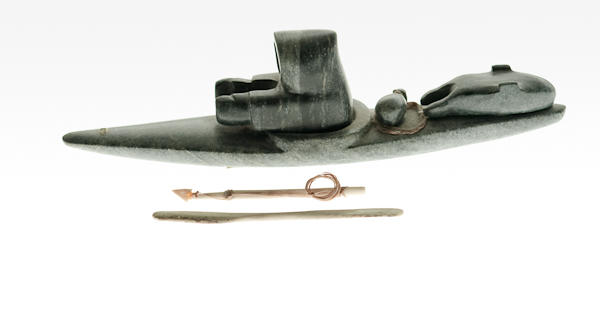
Palliser, William, 1947- Hunter in Kayak, 1996 North West River Area, Labrador

Pisuktie, Josie, 1901-
Bird figure, black
[date unknown]
stone
Iqaluit, Baffin Island region of Nunavut

Sannertannu, Annie Anaronar, 1913-
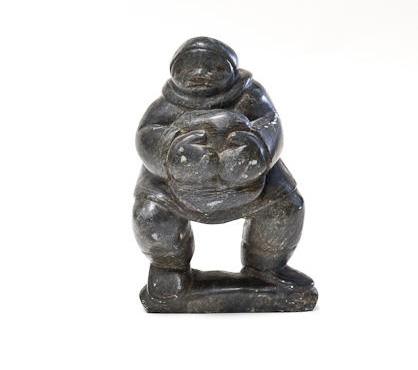
Standing figure
[date unknown]
soapstone
Repulse Bay/ Naujaat in Nunavut