Learn to formulate solid research questions, borrow textbooks, and access the Media Creation Studio and Digital Media Experience Lab. It’s all at the Library!
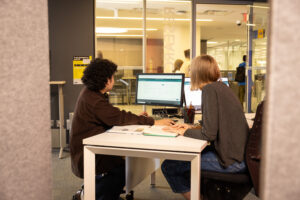 Research help
Researching for a project, essay, or assignment? Visit the Library.
Librarians can help you understand every step of the research process. Whether you are new to research or a graduate student, it’s important to know the resources, process, services, and opportunities available to help you succeed.
Research help is offered in a variety of ways: you can drop in at the Library, request an online appointment, chat in real time, or sign up for a workshop.
It’s easy. Just ask!
Check out these helpful services and resources:
- Learn to formulate effective research questions
- Get research help
- Access the Research Help Guide
- Take a workshop to sharpen your research skills
Access the information you need!
TMU Libraries’ academic search tool allows you to seamlessly access and search the collections, as well as 18 other Ontario university libraries—all in one place, at the same time!
Not only do you have access to hundreds of thousands of ebooks, electronic journals, magazines, professional publications, newspapers, and streaming videos through TMU Libraries, but you can also access over 25 million physical items from 18 other Ontario university libraries.
Feeling overwhelmed and wondering where to start?
Subject librarians can help you understand how to search for, access, and use resources. Find your subject librarian.
Subject guides are curated by subject librarians. These are excellent resources that contain access to research and information in specific subject areas.
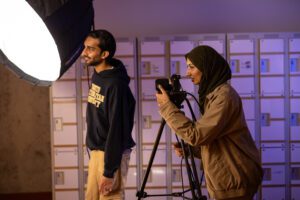 Take advantage of the Media Creation Studio and Digital Media Experience Lab
These spaces and studios are for you! Regardless of what you’re studying, you have access to photography, video, sound editing, and podcasting equipment.
The Media Creation Studio is a beginner space where you can learn video editing, podcasting, or still photography.
The Digital Media Experience Lab is the Libraries’ makerspace. Here you have access to media stations, 3D modelling software, 3D printers, sewing machines, and so much more.
Staff are onsite to assist you whether you’re a beginner or an expert!
Borrow textbooks, laptops, camera kits, and microphones
Of course, you can check out print material at the Circulation Desk, but did you know you can also borrow textbooks, laptops, cameras, tripods, GoPros, and microphones?
Check the loan periods and the equipment borrowing and lending pages for more information.
Specialised collections and spaces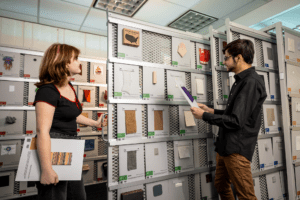
Material ConneXion is an onsite textile and material collection you can explore and research. With this collection, you can gain a tactile understanding of materials. Each sample also includes information about the item: the type of material, its composition, and whether it is sustainable.
While it is available to all students, it is primarily used by interior design, fashion, engineering, architecture, and business students.
The Geospatial Map and Data Centre (GMDC) provides access to specialised geospatial software, data, and statistical resources. The Centre is staffed by data, map, and GIS librarians and analysts, as well as a statistical consultant and learning specialist. Here you can get assistance with GIS information and software, locate and access statistical information and data, and learn how to analyze and present it. There is also a large print map collection!
Special Collections offers access to rare books and primary source material like Canadian World War II comic books, Late Victorian avant-garde magazines, an original chromolithographic edition of the Grammar of Ornament, a thank-you note from Winston Churchill, and so much more. Explore unique research opportunities spanning everything from the history of fashion and graphic design to women artists in the 19th century.
TMU Archives holds the historic record of the university from its origins as a polytechnic institute to its status today as a university. Explore images of campus life from the first days of nursing studies, activism, journalism, and even the construction of the Library building.
Study spaces, computer stations and labs
There are nine floors (2 – 10) available for work and study, each offering different types of spaces and seating options.
There are computer stations and labs, group study rooms, open group tables, and individual carrels and soft seating.
Learn more and find your favourite study spot!