Skip to main menu Skip to content
Learn how to use the new academic search tool, Omni

Author: TMU Libraries

Digital Course Readings/ARES Outage

Please note there will be a Digital Course Readings/ARES Outage due to a necessary server upgrade July 3 from 9 a.m. – 12 p.m. The course readings via the Course Readings tab in Brightspace by D2L will not be available during this time, nor will instructors be able to edit or add readings.


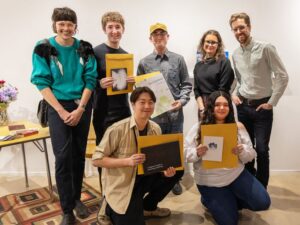
TMU student photobooks capture a generation of photographers

Special exhibition and collection showcase 3rd-year student work

Article by: Lindsey Craig

For most students, a class project ends when the semester does.

But for some TMU photography students, their work becomes part of the university’s permanent record — preserving not only their artistic and creative development, but also a snapshot of the issues, experiences and ideas shaping a generation of emerging artists.

A collection a decade in the making

Since 2015, TMU Libraries has teamed up with the Image Arts program and the Photographic Historical Society of Canada, as donor partner, to build a unique collection of student photobooks.

The work comes from MPS507 – The Photographic Book, a third-year course in which students conceive, design and produce original photobooks using their own photography.

Each January, the books are displayed in an exhibition at Artspace TMU. A panel of professors, artists and industry professionals then selects five or six standout works, which are purchased from the students and added to TMU Libraries Special Collections.

The initiative gives students the chance to have their work recognized, exhibited and – for the award winners, whose work is selected for the collection– preserved in a growing archive available to the TMU community and the public.

“The award provides incentive for students to achieve early recognition that will have a lasting legacy in a collection,” said Alison Skyrme, special collections librarian and The Creative School liaison librarian at TMU Libraries.

Read the full article by Lindsey Craig


Upcoming Scholar’s Portal Outage

Due to an upcoming planned maintenance, all listed services and websites will be temporarily unavailable from Sunday, June 28 at 10 p.m. until Tuesday, June 30 at 11 a.m. 

During this time the following services will not be available:

  • Accessible Content e-Portal
  • Ask a Librarian (virtual reference)
  • Scholars Portal eBooks
  • Borealis
  • Scholars Portal GeoPortal
  • Scholars Portal Journals
  • Odesi
  • Publishing Services

Please plan your research and coursework accordingly to avoid any disruption. We appreciate your patience and understanding as these necessary system updates are completed. 


TMU Libraries acquires knowledge synthesis software Covidence

TMU Libraries is excited to announce the launch of Covidence to support the TMU research community. Covidence is a web-based software platform that is designed to manage and streamline knowledge synthesis work (systematic reviews, scoping reviews, literature reviews, etc). 

To support this launch, we have the following options to help onboard (or welcome) TMU to using Covidence:

  • A Covidence 101 webinar for the TMU community is scheduled on Thursday, June 25, at 10 a.m. – 11 a.m. Please register to attend. This live session will be delivered by Covidence. If this date doesn’t work for you, register, and they will send you the recording.
  • To begin learning about Covidence at any time, please use:
    • TMU Libraries’ Covidence libguide, which includes instructions on how to register for a Covidence account, link an existing account with TMU’s Covidence subscription, and more. 
    • Covidence’s extensive collection of Webinars on Demand
    • Covidence’s extensive Knowledge Base, featuring searchable, step-by-step instructions on all features of the software

If you are new to Covidence, please use the resources above to learn how to use the software and to set up an account connected to TMU. 

For further assistance linking your Covidence account to TMU’s institutional subscription, please email refdesk@torontomu.ca


Exciting Updates & Summer Hours at the Bikram S. Dhillon and Family Medical Library

We are thrilled to share that preparations are officially underway for the grand opening of the rest of the Bikram S. Dhillon and Family Medical Library space in September 2026!

To get everything ready for the next phase, the Medical Library will be undergoing construction over the summer months. Because of this work, it will operate with limited physical hours during the summer.

Please note that the Medical Library team is committed to supporting your research, teaching, and ensuring study needs remains uninterrupted. The team is fully set up to assist you across both physical and digital environments:

  • When our physical space is closed for construction: The team is completely available to support you virtually! You can reach them online for reference assistance, research questions, and resource access.
  • When our physical space is open: They are available to help you both in person and online.

To view the updated summer schedule and plan your visits, please check the Medical Library Hours and Updates page.

If you need to return books to the Medical library and it is closed,  there is a book return box in the School of Medicine atrium. You can also return your books to any of the OMNI libraries in Ontario and they will return them to the Library. 

Thank you for your patience and flexibility as we build an incredible new space for the TMU School of Medicine community. If you have any questions or need research support, don’t hesitate to reach out at medlibrary@torontomu.ca

Celebrating Excellence: TMU Libraries Announces the Inaugural Louise Penny Library Research Award Recipients

TMU Libraries is pleased to announce the inaugural recipients of the Louise Penny Library Research Award: Faculty of Arts students Abigail Apalit and Allison McCausland, and Faculty of Science student Amir Ali Eslami. Following a rigorous committee adjudication process, each student was awarded $2,000 for course papers that demonstrated exceptional critical thinking, independent scholarship, and effective use of library resources.

Launched in January, the award is named after and supported by best-selling Canadian mystery author and library advocate Louise Penny. It recognizes outstanding research papers (2,500 to 4,000 words) written by third- or fourth-year undergraduate students maintaining a minimum 3.0 GPA.

In speaking of the award, Penny says: “Libraries are on the front line of critical thinking, of freedom of expression, of informed choice. In rewarding those who support its Library, TMU is doing a service far beyond the individual or the institution. It is an honour, a pleasure, to be part of that celebration.”

Meet the Inaugural Award Recipients


Abigail Apalit
4th year
Double Major in English and History, Faculty of Arts

Paper title: Stories untold: Rewriting Filipino-American women’s revolutionary care into 20th century American women’s activism

Research process: Abigail navigated archival silences to elevate marginalized community narratives. Her interdisciplinary project seamlessly wove together digital search tools, collaborative library services, and traditional physical archives.

Library Resources Used:

  • Used digitized American newspaper archives to trace historical public discourse.
  • With assistance at the Library’s Research Help drop-in she learned how to locate and work with complex U.S. demographic census data.
  • Used the Library’s Omni search tool to expand searches and access specialized materials available through partner academic libraries.
  • In the onsite stacks, browsed traditional physical collections to uncover critical texts missed by digital keyword searches.

Allison McCausland
3rd year

History Major with minor in English, Faculty of Arts

Paper titled: Great Power Politics and the United Nations in the Cold War 

Research process: Allison conducted a rigorous, evidence-first analysis of complex 1956 case studies. By cross-referencing raw data with historical texts, she built an autonomous thesis before engaging with existing historiography.

Library Resources Used:

  • Accessed primary source materials such as Security Council meeting minutes, historical resolutions, and official veto tallies.
  • From there, used secondary sources and academic archives to critically evaluate and challenge established scholarly frameworks against her own empirical findings.

Amir Ali Eslami

4th year
Computer Science, Faculty of Science

Paper titled: Shade That Sustains: Agrivoltaics and the Future of Biodiverse, Water-Resilient Rural Landscapes

Research process: Amir investigated the multi-disciplinary impacts of solar infrastructure on biodiversity, water resources, and agricultural productivity.  By bypassing basic web searches, he synthesized conflicting scientific viewpoints into a rigorous, evidence-based paper.

Library Resources Used:

  • Using Library databases and searching through peer-reviewed journals, Amir sourced credible literature across environmental, technical, and governance perspectives.
  • Used the Library’s Omni search tools to refine search terms, evaluate methodologies, and build essential information literacy skills.


About Louise Penny:
Louise Penny, a graduate of Toronto Metropolitan University (Radio and Television Arts ‘79), was a CBC journalist before embarking on a remarkable writing career. She has written 20 crime novels in the Armand Gamache series, many of which are New York Times bestsellers, alongside winning numerous literary awards. Her latest book in that series, The Black Wolf, was listed among the Globe & Mail’s 100 most notable books. Penny holds several honorary doctorates, including one from TMU, and is a Member of the Order of Canada and an Officer of the National Order of Quebec. In 2025, she was named Globe and Mail artist of the year


McCaffery’s Carnival gift further establishes TMU Libraries as a leader in Canadian avant-garde poetry collections

TMU Libraries recently became the sole Canadian university library to acquire a rare copy of Carnival: the Complete Edition, the groundbreaking 1973 work by sound poet Steve McCaffery. To celebrate this significant gift, McCaffery joined the TMU Libraries for a special event, where he shared a fascinating talk on the history and impact of the work. 

“We are deeply honored that Steve McCaffery has entrusted TMU Libraries with this seminal work. Decades after its inception, Carnival continues to captivate and challenge audiences with its visionary spirit,” says Mark Robertson, dean of TMU Libraries. 

Begun in the 1960s and completed in 2022, Carnival consists of four massive panels of visual poetry. In it, McCaffery rejects the idea of linear reading, asking the audience to instead engage with the visual, three-dimensional word structures as ‘maps’ of language.

Carnival is now included in TMU Libraries’ expanding collection of books, art, and ephemera relating to the 1970s avant-garde, sound, and concrete poetry movement. This poetry movement was spearheaded in Toronto by a quartet of poets called The Four Horsemen. The group–composed of Steve McCaffery, bpNichol, Rafael Barreto-Rivera and Paul Dutton–pushed the boundaries of traditional poetry with their explorations of ‘concrete’ (visual) and ‘sound’ dimension in performance. 

In the fall of 2025, TMU Libraries celebrated a large-scale donation of bpNichol’s work. The collection, donated by Brian Dedora and Donald Irving, features close to 200 items and provides a window into the Toronto avant-garde literary scene at the time. It includes: a rare and complete series of GrOnk magazines (published by Nichol’s own Ganglia Press); The Adventures of Milt the Morph in Colour, a collaboration between Nichol and artist Barbara Caruso, featuring limited-edition serigraphs; as well as personal ephemera such as handmade Christmas cards and personal notes. The personal items provide a unique glimpse into the literary community and the friendships that fueled this creative revolution.

Together, these donations have put the Libraries’ Special Collections on the map as housing a deep and expanding collection of Canadian avant-garde concrete poetry, offering an insightful look at a 1970s literary movement that broke language away from syntax to create emotional, sonic and three-dimensional experiences with words.

“The addition of Carnival strengthens the bpNichol collection, helping to make TMU a destination for researchers in Canadian avant-garde literary history, concrete poetry, and typography & visual art. We look forward to continuing to grow the collection,” says Alison Skyme, special collections librarian.

This collection provides a multidisciplinary point of entry and many research opportunities for anyone interested in the Canadian avant-garde scene–ranging from the 1970s experimental literary scene, typographical innovation and the use of letters as visual art, to the study of language, performance and visual media.


TMU Libraries and the Aga Khan Museum merge history and high-tech for Game On!

Michael Carter-Arlt, immersive technology specialist, TMU Libraries designed chessboard and puzzle for Game On! exhibit

As the World Cup draws near with matches taking place in Toronto this summer, the Aga Khan Museum has timely launched a spring exhibition called Game On! The exhibition is a vibrant exploration of the creativity and cultural exchange that has existed in games and sports throughout history. It thoughtfully expresses how play builds connections across (and despite) language, religious, and cultural barriers and borders. 

To bring this exhibit to life, the Museum once again sought out expertise at TMU Libraries. This is the fifth collaboration that includes Library digital and physical installations, and archival materials within the historical and cultural conversations of the Museum’s exhibits. 

Through this partnership, TMU Libraries continues to demonstrate how academic resources and digital innovation enhance cultural storytelling.

Immersive Technology Specialist Michael Carter-Arlt has been the Museum’s go-to immersive and digital expert at TMU Libraries. For Game On!, he was asked to work with the Museum to create two custom engagement pieces designed to challenge and intrigue visitors. They include:

  • An interactive chess board designed to ask patrons to solve one of five complex chess problems.
  • A “Game On” puzzle that utilizes applications originally developed for previous TMU installations.
Puzzle designed by Carter-Arlt and UV printed at TMU’s Design & Technology Lab

These items were brought to life at TMU’s Design & Technology Lab using clear acrylic and advanced UltraViolet (UV) printing. Carter-Arlt worked with Adrian Kenny, Mark Francis, and Arnel Espanol at the Lab, along with students Ruslan Galimov and Nina Rastgartalab Tabrizi to fabricate pieces – a collaboration that allowed students to see their work be showcased at an internationally renowned museum.

“Working with the talented team at the Design & Technology Lab has been a pleasure,” says Carter-Arlt. “They consistently produce work of the highest quality and museum-level standards, and their collaborative approach and technical expertise play a huge role in creating engaging interactive experiences that connect visitors more deeply with the exhibition.”

To complement the physical installations, the Museum also connected with TMU Libraries’ Archivist, Tanis Franco. Included in the Game On! exhibition is a nod to a legendary 1968 performance piece titled Reunion, which took place on campus at the then Ryerson Theatre (now the Chrysalis).

Reunion was an experimental chess-based performance by composer John Cage. In it, Cage plays chess against artist Marcel Duchamp on a specialized chess board that generates electronic music based on the moves. Franco assisted the Museum’s curator by sourcing original material from the 1968 event including newspaper clippings, tickets, and advertisements from the production adding historical context to the Museum’s display of the performance.

Reunion archival material from TMU Libraries’ Archives

“Reunion was one performance included in a weeklong experimental art event series called ‘SightSoundSystems’ co-organized by then-Ryerson professor, Donald Gillies. It garnered some interesting and puzzling reviews,” says Franco. “Including this performance as part of the Aga Khan Museum’s exhibit demonstrates how important documenting even a small-scale event is, as it is now known on an international scale. It also reveals that even back then,TMU was pushing the boundaries of art and expression.”      

Through the fabrication of games and extensive archival research, TMU Libraries helped the Game On! exhibition showcase play as an important lens through which to communicate cultural histories. This collaboration once again highlights the role of academic libraries in providing depth to cultural narratives.


This TMU librarian creates crosswords for The New York Times – and one for TMU

Article By: Lindsey Craig

Head Law Librarian, Nam Jin Yoon

From lawyer to librarian, Nam Jin Yoon turned a passion for puzzles into a creative outlet

During the pandemic, when many people found themselves mastering the art of baking banana bread or binging Friends or Tiger King, Nam Jin Yoon found himself drawn to a different kind of daily ritual: crosswords.

Yoon first picked up the habit while working as a lawyer in Boston, as he needed something to calm his mind before bed.

“It wasn’t activating it more; it was just sort of using what was there,” he explained.

That habit quietly grew into something bigger. Today, Yoon is head law librarian at TMU Libraries’ Law Library – and a published crossword creator for The New York Times.

Can you teach me how to do this thing?

The leap from solving puzzles to creating them was a natural progression.

“I really liked some of The New York Times crosswords, so I reached out to them (crossword constructors), like, ‘Hey, can you teach me how to do this thing?’”

He didn’t expect much. But the community embraced his curiosity and began to show him the ropes. Eventually, he was submitting puzzles of his own to the Times.

Each one takes roughly 20 hours to build.

Yoon begins by building the grid and filling it with interlocking words, then crafts clues designed to make solvers see those words in new and unexpected ways.

Lawyer to librarian

Yoon didn’t set out to become a librarian. He went to law school to feed a natural curiosity. But, as his legal career progressed, he realized what he enjoyed most wasn’t necessarily practising law — it was the research.

That realization led him to pursue library school and, eventually, law librarianship.

In 2025, along with his Canadian partner, he relocated from New York to Toronto — where he also lived as a young child. That’s when he joined TMU.

Being a law librarian, he says, came with an unexpected perk: immediate, tangible impact.

“You get thanked all the time,” he said. “You can more immediately help the person across from you, and you have the expertise to help them get what they need,” he said, contrasting the experience to law, where cases can take years to be resolved.

Helping others navigate AI

Helping students and faculty navigate an increasingly complex information landscape has become a critical part of his role.

“AI has made it more difficult to know what information is credible and what’s not,” he said. “So, our job is less about helping people find a particular book, but being able to find credible sources and not be lost in the sea of information.”

He also teaches legal research to law students.

“The emotional IQ of the students here is off the charts,” he said, in part crediting the video submission requirement of the admissions process, as opposed to simply test scores.

“You can really see the passion. They’re so eager to learn and to help each other,” he said.

While juggling his TMU roles, Yoon continues to create crosswords for The New York Times — and has also designed one specifically for TMU.

“The TMU one I made was pretty fun,” he said. “There was something satisfying about designing it for TMU students in particular.”

Creating a puzzle for a specific audience adds another layer to the process.

“You’re just trying to think of, ‘Okay, like, how would a TMU student… think about this word or this concept?’” he said, also noting that he also had to check his “Americanisms” in spellings.

Even now, crossword construction remains a personal and meaningful practice — one that mirrors the kind of thinking he values in both research and teaching.

“It’s one of those things where… the more time you sink into it, the better you feel about it,” he said.

And for those ready to take on his latest creation, there’s an added incentive: somewhere within the grid, a few pieces of TMU are waiting to be discovered.


Reminder: Clear Fines and Return Overdue Items

As the Winter 2026 term wraps up, please ensure any outstanding fines are paid and overdue items are returned. Students with fines more than $25 or overdues will not be able to view their grades until their accounts are cleared.

You can pay fines at the Circulation Desk (Visa, MasterCard, American Express, or OneCard) or by phone at 416-979-2149. We do not accept personal cheques.

For questions, contact us at access@torontomu.ca

Good luck with your exams!