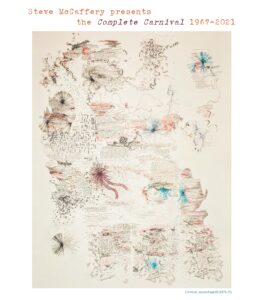
TMU Libraries recently became the sole Canadian university library to acquire a rare copy of Carnival: the Complete Edition, the groundbreaking 1973 work by sound poet Steve McCaffery. To celebrate this significant gift, McCaffery joined the TMU Libraries for a special event, where he shared a fascinating talk on the history and impact of the work.
“We are deeply honored that Steve McCaffery has entrusted TMU Libraries with this seminal work. Decades after its inception, Carnival continues to captivate and challenge audiences with its visionary spirit,” says Mark Robertson, dean of TMU Libraries.
Begun in the 1960s and completed in 2022, Carnival consists of four massive panels of visual poetry. In it, McCaffery rejects the idea of linear reading, asking the audience to instead engage with the visual, three-dimensional word structures as ‘maps’ of language.
Carnival is now included in TMU Libraries’ expanding collection of books, art, and ephemera relating to the 1970s avant-garde, sound, and concrete poetry movement. This poetry movement was spearheaded in Toronto by a quartet of poets called The Four Horsemen. The group–composed of Steve McCaffery, bpNichol, Rafael Barreto-Rivera and Paul Dutton–pushed the boundaries of traditional poetry with their explorations of ‘concrete’ (visual) and ‘sound’ dimension in performance.
In the fall of 2025, TMU Libraries celebrated a large-scale donation of bpNichol’s work. The collection, donated by Brian Dedora and Donald Irving, features close to 200 items and provides a window into the Toronto avant-garde literary scene at the time. It includes: a rare and complete series of GrOnk magazines (published by Nichol’s own Ganglia Press); The Adventures of Milt the Morph in Colour, a collaboration between Nichol and artist Barbara Caruso, featuring limited-edition serigraphs; as well as personal ephemera such as handmade Christmas cards and personal notes. The personal items provide a unique glimpse into the literary community and the friendships that fueled this creative revolution.
Together, these donations have put the Libraries’ Special Collections on the map as housing a deep and expanding collection of Canadian avant-garde concrete poetry, offering an insightful look at a 1970s literary movement that broke language away from syntax to create emotional, sonic and three-dimensional experiences with words.
“The addition of Carnival strengthens the bpNichol collection, helping to make TMU a destination for researchers in Canadian avant-garde literary history, concrete poetry, and typography & visual art. We look forward to continuing to grow the collection,” says Alison Skyme, special collections librarian.
This collection provides a multidisciplinary point of entry and many research opportunities for anyone interested in the Canadian avant-garde scene–ranging from the 1970s experimental literary scene, typographical innovation and the use of letters as visual art, to the study of language, performance and visual media.