Skip to main menu Skip to content
Learn how to use the new academic search tool, Omni

News

Library Budgets in the News

Earlier this week, the news broke that Memorial University of Newfoundland (MUN) is reviewing 2,500 journals and looking for cost savings where possible. The response has been an outcry from the professoriate at MUN. We thought this was a good opportunity to discuss the collections budget at Ryerson.

Can we anticipate similar activities at Ryerson?

Yes, we can. Academic libraries across the country are enduring a budget crisis. The librarians at Ryerson have been diligently undertaking analysis of our collections to determine where we can find maximum savings with minimal effect on the community. Liaisons are working directly with their departments to keep faculty informed of developments that may affect them. If you are concerned about journals or databases specific to your area, please contact your liaison librarian.

Why are collections being targeted in budget reduction scenarios?

Along with all other departments on campus, the library has had to reduce its base budget for eight consecutive years. Sustaining journal subscriptions on an annual basis requires base funding. Given that our subscription costs have a standard inflation rate of 5-10% per year, this alone has created a difficult situation. Coupled with the historic low of the Canadian dollar – like MUN, the vast majority of our subscriptions are billed in US dollars – we find ourselves in an unprecedented situation, and must make difficult decisions. We simply cannot maintain our current levels of spending within the confines of our reduced budget allocation. Unless the Canadian dollar recovers, we can continue to expect the loss of access to some resources.

How can we maintain our reputation if we don’t have access to the latest research?  

Librarians are working hard to ensure that we are not sacrificing core journals. We also provide access to top-notch document delivery services, sometimes providing access to PDF articles held by other university libraries in your email in under 48 hours. In some cases, we are maintaining access to a journal via an aggregator database with embargoed access. These embargo periods are set by the publishers and are not within our control. We encourage faculty who may be on editorial boards address this issue and advocate for an end to embargoes and turn toward more progressive Open Access policies.

What can I do to prevent further cuts to the library budget?

Advocacy is key. As publishers reap profit margins of upwards of 40%, academic libraries simply cannot keep pace with the cost of subscriptions – and nor should we. As viable Open Access models emerge, we must band together and be forces for change. The Tri-Council agency has demonstrated leadership in this area with their new Open Access policy. This is the beginning of a sea change – we must be part of it and see the opportunity that has been presented in challenging circumstances.

Further reading:

Academic publishers reap huge profits as libraries go broke– CBC news, June 15, 2015

Academic publishers make Murdoch look like a socialist” – Guardian, August 29, 2011


Corrections made December 14, 2015:

  • Clarification that MUN is reviewing journals for cancellation but has not undertaken any cancellations as of this post.
  • Turnaround time for Document Delivery journals can be as quick as 48 hours.

New Laptops

new_dell_laptopsSixty new Dell Latitude 3340 laptops have been added to the Library’s mobile learning programme.  They are now available for borrowing from the Circulation Desk.  All the new laptops are equipped with Windows 7 and include the Adobe Creative Suite and Microsoft Office.  Check our website for a complete list of software available on these machines.

Laptops may be borrowed for a four hour period during the hours that the Library is open. The first time you borrow a laptop, you will need to complete and submit an online Laptop Loan Agreement Form.

Introducing Ryerson Library’s Open Access Wall of Fame

Ryerson Library is very proud to announce the inaugural inductees for the Library’s Open Access Wall of Fame!

The Wall of Fame honours researchers who have demonstrated a commitment to ensuring their research is open and available to all. Our aim is to acknowledge and support those who consider open access avenues when publishing their work. Open Access material is scholarly work that is made legally available with no restrictions so the anyone can access the full text.

This year’s inaugural inductees are Dr Harald Bauder and Dr Enza Gucciardi.

Portrait of Dr Harald BauderDr Bauder is the Academic Director of the Ryerson Centre for Immigration & Settlement and a graduate Professor in Immigration & Settlement Studies and the Department of Geography. Dr Bauder has been a long-time supporter of Open Access publishing, participating as both as writer and an editor. He was the editor of the journal ACME: An International e-Journal for Critical Geographies  for nearly a decade and also served as editor of the open-access book publisher Praxis (e)Press. Through Praxis (e)Press, Dr Bauder published the textbook Critical Geographies: A Collection of Readings with Salvatore Engel-di Mauro. In addition, as the inaugural Academic Director of the Ryerson Centre for Immigration and Settlement (RCIS), Dr Bauder founded and edited the open-access RCIS Discussion Paper Series and the RCIS Research Briefs. Other Open Access publication venues include Comparative Migration Studies, the CERIS Working Paper Series, and popular media, such as Open Democracy. For more information about Dr Bauder’s work, including links to his publications, please see his faculty page.

E. Guacciardi (2)Dr Gucciardi is an Associate Professor in the School of Nutrition and an Affiliate Scientist with the Toronto General Hospital Research Institute. She has written over a dozen publicly-accessible manuscripts on diabetes research. On the subject of open access, she writes:

I feel that everyone should have equitable access to publicly-funded research. Many libraries cannot purchase all of the journals available, particularly in less developed countries; thus, open access material helps to support research at all institutions worldwide. I also believe that publishing in open access journals will help attain a higher level of impact from greater numbers of citations. Ultimately, if all research is moved out from behind paywalls, our work can inspire broader collaboration, proliferate more research and potentially have greater benefits on society globally.

For more information about Dr Gucciardi’s work, including selected publications, please see her website.

Congratulations to Dr Bauder and Dr Gucciardi! Ryerson Library is honoured to have you as our first Open Access Wall of Fame inductees.

Celebrate Open Access Week with Ryerson Library!

International Open Access Week takes place October 19th to 25th, 2015! Open Access material is work that is made legally available on the public Internet with no restrictions so the anyone can access the full text. To celebrate this important cause, the Library is proud to host the following events.

1) The Internet’s Own Boy: The Story of Aaron Swartz

This documentary film will be streaming on Tuesday, October 20th between 10:00 AM and 5:00 PM in the SLC amphitheatre.  The film depicts the life of American computer programmer, writer, political organizer, Internet activist, and lifetime open access advocate, Aaron Swartz.

2) Free Webinar: Faculty Perspectives on Publishing Open Access

Anyone can register for this free webinar to watch it online, or you can drop by LIB489B on Tuesday, October 20th at 2:00 PM and join library staff for a group viewing.

Reports find that perceptions of open access publishing are changing for the better and that more and more faculty members are seeking out OA publications for maximum access and impact. However, other researchers continue to avoid it, and those who are early in their careers still aren’t sure how to fit it in their publishing priorities. In honor of Open Access Week, this one-hour webinar will feature three faculty members who will discuss why researchers do – or do not – publish in open access outlets and how they look to librarians for support in this process.

Alan Daly, Chair and Professor of the Department of Education Studies at the University of California, San Diego, will discuss how open access publishing is the best option for the individual researcher and the research community as a whole. Bruce Herbert, Professor of Geology and Director of the Office of Scholarly Communications at Texas A&M University, will discuss why researchers at his institution avoid open access outlets for publishing research and why subscription-based journals remain the best option for many. Shannon Audley-Piotrowski, Assistant Professor of Educational Psychology at Smith College, will discuss publishing priorities for early-career researchers.

3) Free Up Your Teaching: An Introduction to Open Access Material (LTO workshop)

Wednesday, October 21st 2015, 12:00pm – 2:00pm, POD 372

When combined with creative commons materials, public domain historical materials, and open access journals and books, the Fair Dealings Exception to the Copyright Act implies a greater amount of available content. Learn where to locate free textbooks and images to augment your PowerPoint slides.

Michelle Schwartz, LTO Research Associate, and Ann Ludbrook, Copyright Librarian, will offer tips, resources and information on library services available to reduce the work required to compile course readings. Dr. Nancy Walton, Director of e-Learning, will discuss practical application of open access materials to enhance your teaching.

Register for this workshop now.

Celebrate Aboriginal History Month with RULA!

bigaboriginallogoJune is National Aboriginal History Month!

The Library has been working hard to expand our collection of resources related to the first nations people of North America, including 100 DVDs. You can also check out the Library’s new Aboriginal Research portal to find books, articles, and community resources on aboriginal topics.

There are also dozens of events happening around the city to celebrate National Aboriginal History Month – check out this list from Muskrat Magazine as well as these Toronto Public Library events, taking place at branches across the city.

Mother’s Day… by the Numbers

Did you know that there were 9.8 million mothers in Canada (including biological, adoptive and stepmothers) in 2011?  Check out Statistics Canada’s Mother’s Day in Canada for more information about this special day… by the numbers.

For more information about data and statistics resources available at the Library, contact librdata@torontomu.ca or visit the Library’s data pages.


Thank You to Our Wonderful Student Employees!

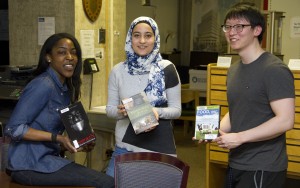
On April 14th, Ryerson Library hosted the annual Student Staff Appreciation Party and recognized our Student Employee of the Year Award recipient. The Student Employee of the Year Award recognizes students who have achieved excellence in their work environment, and the winners receive an award as well as a cash gift.  Again this year, the selection committee had a difficult time choosing just one recipient, and ultimately recognized two Ryerson students: Carlene Jacob, and Andres Hernandez.

andres-madeleine-carlene


This event also recognized graduating student employees Andres Hernandez, Mehak Saini, Marjan Hajipour, Bertha Lee, and Slimane Bakelli, who each selected a book to be added to the Library collection.

Congratulations and best of luck in the future!

IMG_9881-small

New Resource: Oxford Bibliographies Online – Cinema & Media Studies

The Library is pleased to provide access to Oxford Bibliographies Online – Cinema & Media Studies. The bibliographies are a carefully organized, thoroughly peer-reviewed account of the most important books, articles, and websites relating to cinema and media studies.

Connect to Oxford Bibiographies Online – Cinema and Media Studies


Oxford Bibliographies Online (OBO) is an entirely new research tool for the social sciences and humanities. A scholar-curated library of discipline-based subject modules, OBO is designed to help busy researchers find reliable sources of information in half the time by directing them to exactly the right chapter, book, website, archive, or data set they need for their research. Each entry is a selective guided tour through the key literature on a topic, receives multiple peer-reviews as well as Editorial Board approval, and is designed to facilitate a research experience with no dead ends. All citations are linked through to your collection via OpenURL, full-text via DOIs, or to the web via links to OCLC, WorldCat, and Google Books, allowing users to locate quickly full-text content directly from OBO. OBO is the ultimate collection development tool for librarians and time saving tool for students and researchers.

ProQuest Dissertations and Theses Goes Global

PQDT Global now includes citations and often full text access to PhD dissertations and Master’s level theses from universities in the UK and Ireland, adding to its strong coverage of North American and European graduate research.

All dissertations published after mid-1980 include author supplied abstracts. Brief abstracts are available for masters theses published since 1988. Most of the content created after 1997 is available in full text and selective earlier works are also available in full text. Millions of other works created prior to this period and as early as the 17th century are discoverable from bibliographical citations. And the database continues to grow with around 700 universities continuing to contribute new content to this database.

Many universities, including Ryerson, are populating local open access digital repositories with their graduate students’ dissertations, theses, and in some cases, major research papers. The open access movement seeks to make scholarship available to users without charge rather than limiting access to those who can pay subscription and purchase fees. Many tools promote the discovery and access to graduate students’ research. Examples include Open Access Theses and Dissertations, DART-Europe E-theses Portal, and Google Scholar. For more suggestions visit the RULA Theses and Dissertations Research Guide.


With Captioning, Everything is Awesome

That GIF above wouldn’t mean much without those captions. So you can imagine how frustrating it would be to watch an entire video with the sound off – especially if it’s mandatory viewing for your class. This is a situation that we’re working hard to prevent for students across our campus.

The Ontario Council of University Libraries (OCUL) has recently published the ROAM report on how we can increase accessibility to our media collections. As a member of OCUL, the Ryerson Library is committed to making classroom materials accessible. We work with students, faculty and Academic Accommodation Support to caption videos and online video clips. We’ve also taught ourselves how to caption with free software like YouTube and Amara.

So if you’re a student, staff or faculty member interested in making videos, please caption! We’ll give you some advice on how to get started. Contact us on how to caption to make your content more awesome!


For more information, please check out our captioning program.